
First aid in the driving theory test: questions and duties
First aid questions appear in both parts of the theory test, and in the specialist part they are usually worth 3 points. They test the law (art. 44 of the Road Traffic Act, art. 162 of the Criminal Code), the emergency number and how to treat a casualty. Below: how the catalogue asks, what the law requires, a table of situations and a cheat sheet with answers.
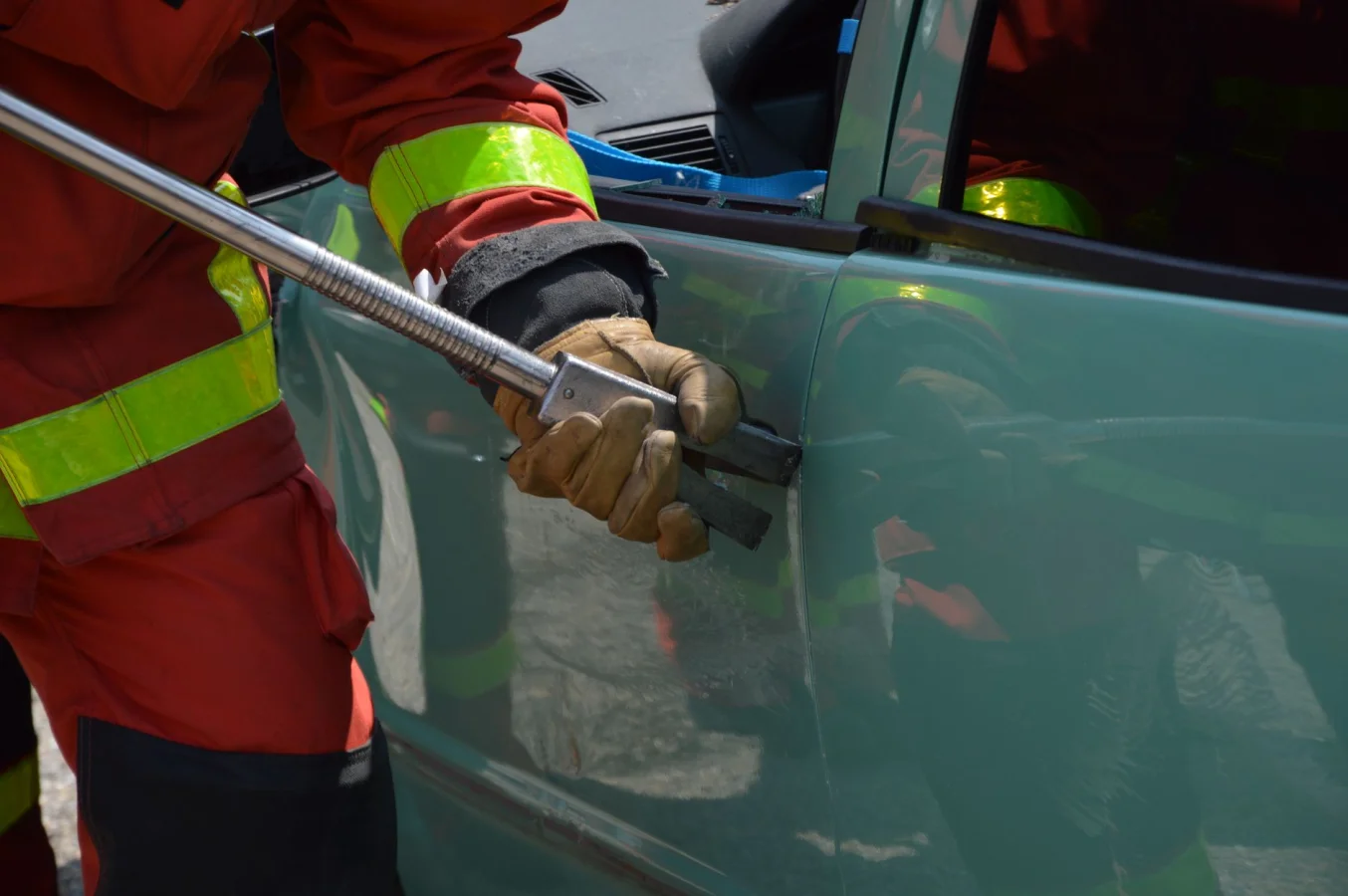
Photo: Ulrick Trappschuh / Pexels
This guide covers the Polish driving licence and the rules that apply in Poland. Legal status checked on 13 September 2026.
First aid questions appear in both parts of the test: the law, the emergency number and treating a casualty. Everyone must help: an accident participant (art. 44 Road Traffic Act) and anyone (art. 162 Criminal Code). Failing to help means up to 3 years in prison, for a driver also 15 points. Ambulance: 112 or 999.
Where the first aid questions in the driving theory test come from
First aid questions are part of the official question catalogue of the Ministry of Infrastructure (Ministerstwo Infrastruktury), the same one from which the system at WORD (Wojewódzki Ośrodek Ruchu Drogowego: the regional test centre) draws the 32 questions for the theory test. They appear in both parts of the test. In the basic part (YES/NO answers) almost all the questions on the list below are worth 1 point (the exception is 14108, worth 3 points), for example whether, as a participant in an accident with injured people, you are required to call the emergency services and give help (6298: YES). In the specialist part (A/B/C) first aid questions are usually worth 3 points, for example which number you call for an ambulance (6459) or what to do with a casualty inside a vehicle (4563).
Three points is a lot. You pass from 68 out of a possible 74, so two mistakes in 3-point questions use up the whole permitted margin, and a third means a fail. We explain how the scoring works in the article on the number of questions and scoring in the theory test.
The knowledge for these questions comes from two places: the law, meaning art. 44 of the Road Traffic Act (Prawo o ruchu drogowym) and art. 162 of the Criminal Code (Kodeks karny), and the first aid classes that are part of the course at an OSK (ośrodek szkolenia kierowców: a driving school), under art. 23 of the Act on Vehicle Drivers (ustawa o kierujących pojazdami). This text sets out how the catalogue asks and what the law requires. It does not replace a first aid course. In a real situation the emergency call operator gives you step-by-step instructions, so you call early and listen. That is practical advice, not a legal rule.
Who has a duty to help and what the penalty is for failing to do so
The duty comes from two provisions. The first concerns a participant in the accident, the second every person.
Art. 44(2) of the Road Traffic Act: a driver involved in an accident in which someone is killed or injured is required to:
- give the necessary help to the victims of the accident and call the emergency medical team and the Police (point 1);
- not take any action that could make it harder to establish the course of the accident (point 2);
- stay at the scene of the accident, and if calling for help required leaving it, return without delay (point 3);
- until the Police arrive and test them, refrain from alcohol and substances with a similar effect (point 2a).
Para. 3 applies the same duties accordingly to the other people involved in the accident. When no one is killed or injured, the duties look different: you move the vehicle from the scene and give your details (para. 1), and you do not have to call the Police (6296: NO). We describe the full procedure after a minor collision in the article on the driver's duties after a collision or accident.
Art. 162 of the Criminal Code applies to everyone, not only drivers. Para. 1: whoever fails to give help to a person in a situation of immediate danger of loss of life or serious harm to health, while being able to give it without exposing themselves or another person to such danger, is liable to imprisonment for up to 3 years. Para. 2: a person does not commit an offence if they fail to give help that would require them to undergo a medical procedure themselves, or where immediate help from an institution or a person appointed for that purpose is available.
The catalogue tests this in several questions. Everyone has a duty to help, including people with no medical qualifications (3658: YES; 6465: B, because some rescue actions can be carried out on your own). Criminal liability applies to any person who could have given help without exposing themselves or another person to danger (4562: A). It is incurred for failing to give any help at all, not for unprofessional or mistaken action (6453: A).
On top of that come penalty points: failing to help accident victims is 15 points (code A 04 in the regulation on the register of drivers who breach traffic rules, as of September 2026). There is no fine amount for it in the fines tariff: failing to give help is a crime under art. 162 of the Criminal Code, and for a driver involved in the accident also a petty offence under art. 93 of the Code of Petty Offences (Kodeks wykroczeń), punishable by detention or a fine and a driving ban. We explain what 15 points mean for a driver in their first year in the article on penalty points and losing your driving licence.
How to call for help: 112 or 999 and what to tell the operator
You call an ambulance on 112 or 999 (6459: C). The answers 997 and 998 in this question are distractors. You can check the wording and the answer on the page of question 6459 on the number for an ambulance.
The order of the conversation with the operator follows directly from the catalogue questions:
- First you state the location of the incident (2432: YES).
- You give the location and the number and condition of the accident victims (4578: A). "Only the number of vehicles" and "only the number of victims" are wrong answers.
- You describe the location by the street name and building number, or by the road number, the name of the nearest town and the kilometre marker post (6454: A). The name of the town alone is not enough, and the caller's phone number is not the most important piece of information.
- You give your identification details (7646: YES).
One detail from level crossings: the crossing number given to the 112 operator indicates the exact position of the crossing on which the vehicle has broken down (14108: YES).
You are alone at the scene: first the phone call, then resuscitation
The catalogue settles the order when you are the only person at the scene. Question 7645 asks: should you, without first calling for help, start resuscitating an injured person when you are alone? The answer: NO. Conclusion: alone at the scene, you first call for help and only then start resuscitation.
You continue chest compressions and rescue breaths on a person in sudden cardiac arrest until the emergency medical team arrives (2165: A). "For 15 minutes" and "as long as the body keeps the right temperature" are distractors.
When looking for injured people, you check every space of the wrecked vehicle, including the boot (7643: YES). If you see people in a burning car, you are required, if possible, to give them first aid and call the fire brigade (2438: YES). Question 2457, with a video, asks the same thing in a scene from the road: you stop, give the necessary help and notify the emergency services (YES).
A casualty inside the car: when to evacuate and when to leave them
Here both extreme answers are wrong. Question 4563 gives three options: evacuate in every case (A), evacuate from the vehicle if cardiac arrest is found (B), always leave in the vehicle until a doctor arrives (C). The correct one is B.
The second exception is smoke. You evacuate a casualty from a smoking car, keeping your own safety in mind (2445: YES). Likewise, you do not leave a person with their face submerged in water out of concern for their spine (2476: NO).
If a cervical spine injury is suspected, you stabilise the head by hand until a member of the emergency medical team takes over the stabilisation (2183: B), not until the casualty starts moving it. An injured person who has regained breathing but is unconscious is placed in the recovery position (7648: YES). The catalogue also asks why: because it prevents airway obstruction and choking (6468: C), not for comfort and not because of the cervical spine.
Bleeding, burns, burning clothes, hypothermia: table of situations
Below are all the situations from the catalogue questions concerning the treatment of a casualty, with the answer and the question number.
| Situation | What you do according to the catalogue | Question number and answer |
|---|---|---|
| Bleeding | you apply a pressure dressing | 2164: C |
| A heavily bleeding wound | a pressure dressing made of gauze or a bandage, not iodine or gentian violet | 6467: B |
| No sterile dressing | you use the casualty's clothing for the dressing, you do not wait for a first aid kit | 2161: B |
| A burn | you may pour cold water over it | 7649: YES |
| The casualty's clothing is on fire | you bring the person down to the ground and put out the fire by covering it, e.g. with a jacket, blanket or coat | 4579: A |
| Protecting an injured person from losing heat | a thermal foil blanket with the gold side on the outside | 7647: YES |
| A person on the roadside in winter who is blue, semi-conscious and hypothermic | you call the emergency medical team, take them into the car, cover them and warm them up slowly; no hot drink and no alcohol | 6463: C |
| A casualty inside the vehicle | evacuation if cardiac arrest is found | 4563: B |
| A smoking car | evacuation, keeping your own safety in mind | 2445: YES |
| Face submerged in water | you do not leave them in that position | 2476: NO |
| Suspected cervical spine injury | manual stabilisation of the head until a member of the emergency medical team takes over | 2183: B |
| Unconscious, breathing | recovery position | 7648: YES, 6468: C |
| Sudden cardiac arrest | chest compressions and rescue breaths until the emergency medical team arrives | 2165: A |
| You are alone, the injured person needs resuscitation | you call for help first | 7645: NO |
| The role of the head restraint in an accident | correctly adjusted, it protects the cervical vertebrae | 4484: B |
| First aid kit in a passenger car | not compulsory, but good to have | 6452: B |
Head restraints and seat belts are prevention, not rescue, but the catalogue keeps them close to the accident questions. We describe how seat belts work, who must wear them and what the exceptions are in the article on seat belts and child car seats.
Traps in the first aid questions
Here are the answers that sound logical but contradict the law or the wording of the question:
- The number for an ambulance is 112 or 999. The answers 997 and 998 in question 6459 are wrong.
- A first aid kit is not compulsory equipment for every motor vehicle; you do not have to have one in a passenger car (6452: B). The answer "yes, if it has a gas (LPG) system" is a distractor.
- "Only a doctor" and "only a participant in the accident" are not correct. Everyone has the duty (6465: B), and liability applies to anyone who could have helped without exposing themselves or another person to danger (4562: A).
- Moving the vehicle from the scene is a duty only when no one is killed or injured (6297: YES). When there are injured people, you have no right to move the vehicle "so as not to block traffic" (6294: NO).
- "Evacuate in every case" is wrong (4563: B), but you do evacuate from a smoking car (2445: YES).
- You do not urge the person at fault to drive the casualty to hospital themselves when the emergency services are on their way (2430: NO).
- You do not leave the scene after calling the emergency services (6292: NO), after giving help but before the Police arrive (3673: NO), or because "the person at fault will give help" (2420: NO).
- You do not take any action that could make it harder to establish the course of the accident (7241: NO).
We have collected more patterns like these, including video and photo questions, in the article on the most common mistakes in the theory test.
Is first aid tested in the practical test
No. The set of first aid questions is part of the theory test, in the basic and the specialist part. In the practical test the examiner assesses preparation for driving, the vehicle checks, the manoeuvring area and driving in traffic. There is no first aid task in the regulation on driving tests.
One motorway question is, however, linked to practice. If while driving you start to feel short of breath, get the shivers, your hands go numb and you feel pain around the stomach and ringing in your ears, you carefully pull onto the hard shoulder, call the Emergency Medical Services and unfasten your seat belt (6456: B). Driving on to the hospital, even with the window open, is wrong. We explain how to mark a stationary vehicle and where to place the warning triangle on a motorway in the article on the rules for driving on motorways and expressways.
Cheat sheet: questions on duties and calling for help, with answers
The questions on treating a casualty are in the table above. Here we have gathered the rest of the list: on the duties of a participant in an accident and on the conversation with the operator. Points are given according to the catalogue.
| Number | What it asks | Points | Answer |
|---|---|---|---|
| 6298 | whether, as a participant in an accident with injured people, you must call the emergency services and give help | 1 | YES |
| 6404 | which action a participant in an accident with injured people is required to take | 2 | C: give the necessary help to the victims and call the emergency medical team and the Police |
| 3658 | whether you must help the injured if you have no medical qualifications | 1 | YES |
| 6465 | whether everyone has a duty to give first aid | 3 | B: yes, some rescue actions can be carried out on your own |
| 4562 | who is criminally liable for failing to give help | 3 | A: any person who could have helped without exposing themselves or another person to danger |
| 6453 | which behaviour towards an injured person can result in criminal liability | 3 | A: failing to give any help at all |
| 2457 | video: whether you must stop, give help and notify the emergency services | 1 | YES |
| 2438 | people in a burning car: help and calling the fire brigade | 1 | YES |
| 2420 | whether you may leave the scene because the person at fault will give help | 1 | NO |
| 2430 | whether to urge the person at fault to drive the casualty to hospital | 1 | NO |
| 6292 | whether you have the right to leave the scene after calling the emergency services | 1 | NO |
| 3673 | whether you may drive away after giving help but before the Police arrive | 1 | NO |
| 7241 | whether you may take actions that make it harder to establish the course of the accident | 1 | NO |
| 6294 | whether, with injured people, you have the right to move the vehicle so as not to block traffic | 1 | NO |
| 6296 | whether, with no one killed or injured, you must call the Police | 1 | NO |
| 6459 | the number you call for an ambulance | 3 | C: 112 or 999 |
| 2432 | whether, when calling, you first state the location of the incident | 1 | YES |
| 4578 | what information to give when calling the emergency number | 3 | A: the location of the incident and the number and condition of the victims |
| 6454 | the most important information identifying the location of the accident | 3 | A: street and building number or road number, nearest town, kilometre marker post |
| 7646 | whether to give your identification details | 1 | YES |
| 14108 | whether the level crossing number given to the 112 operator will indicate its position | 3 | YES |
| 7645 | whether, alone at the scene, you start resuscitation without calling for help | 1 | NO |
| 7643 | whether you check every space of the vehicle, including the boot | 1 | YES |
You can practise all these questions, with an explanation and a reference to the legal provision, on the list of category B test questions, and under conditions like those at WORD, with a time limit per question, in the category B mock test. We explain how to spread your study over two weeks in the study plan for the theory test.
A practical tip to finish: in this group of questions look for the words "killed or injured". If the wording mentions injured people, almost every answer about driving away, moving the car or leaving the matter to the person at fault is wrong. If no one is injured, the duties change to moving the vehicle and exchanging details.
Frequently asked questions
How many points are the first aid questions worth in the test?
It depends on the part of the test. Questions from this group in the basic part (YES/NO) are usually worth 1 point (14108 is worth 3), and in the specialist part (A/B/C) 2 or 3 points. All 32 questions are drawn from the catalogue in real time, and the pass mark is 68 out of 74 points.
Do I have to give first aid if I have no medical training?
Yes. The catalogue asks this directly (3658: YES; 6465: B), and art. 162 of the Criminal Code does not require qualifications. What is punishable is failing to give any help at all, not a mistake by someone who tried to help (6453: A).
Which number do I call for an ambulance: 112, 997, 998 or 999?
You call 112 or 999 for an ambulance (question 6459, answer C). In this question the numbers 997 and 998 are distractors.
What is the penalty for failing to help accident victims?
Imprisonment for up to 3 years under art. 162 para. 1 of the Criminal Code, if you could have helped without exposing yourself or another person to danger, plus 15 penalty points (code A 04, as of September 2026). There is no fine amount in the fines tariff; for a driver involved in the accident it is also a petty offence under art. 93 of the Code of Petty Offences (detention or a fine and a driving ban).
Can I drive away from the accident scene after calling an ambulance?
No. A participant in an accident with injured people stays at the scene, and if they left to call for help, they come back (art. 44(2) point 3). The catalogue tests this in questions 6292, 3673 and 2420, all with the answer NO.
Is a first aid kit compulsory in a passenger car?
No. A first aid kit is not compulsory equipment for every motor vehicle, and you do not have to have one in a passenger car, although it is good to have (question 6452, answer B). The gas system condition in this question is a distractor.
Does the examiner test first aid in the practical test?
No. The regulation on driving tests does not provide for such a task. First aid appears only in the theory test questions and in the classes on the course at an OSK.
Related exam questions
- 6298If you're involved in a car accident in which there are injured parties, are you obliged to call the emergency service and provide the necessary assistance to the victims?
- 6404What are responsibilities of the person involved in the traffic accident in which there are victims?
- 3658You are involved in a road accident. Are you obliged to give first aid to the injured persons if you do not have medical qualifications?
- 6465Is everyone obliged to give first aid to victims of accidents?
- 4562In the case of not giving first aid to the road accident casualty who is in life endangerment situation the criminal responsibility is on:
- 6453Which of the following actions towards a person injured in an accident may entail penal liability?
- 2457Are you obliged to stop and inform the emergency services in this situation?
- 2438Seeing people in a burning car, are you obliged to administer first aid to them and inform the fire brigade?
- 2420Are you allowed to leave the scene of the accident because you believe that the perpetrator of the accident will give first aid to the injured person?
- 2430You know that the emergency services will arrive to the scene of the accident soon. Should you persuade the perpetrator to take the injured person to the hospital?
- 6292If you're involved in a car accident in which there are injured persons, can you leave the scene of the accident once the ambulance service has been called?
- 3673You have been involved in a road accident as the driver of the vehicle. After administering first aid to the injured persons, are you allowed to leave the scene of the accident before the arrival of the police?
- 7241You have participated in a car accident with casualties. Are you allowed to undertake actions which might hinder establishing the course of the accident?
- 6294If you're involved in a car accident in which there are injured parties, can you remove your car from the scene of the accident so that it does not create an obstacle to traffic?
- 6296If you're involved in a car accident in which there are no injuries or fatalities, are you obliged to call the Police?
- 6459Which of the following numbers should you call in order to call an ambulance to the scene of a road accident?
- 2432When calling the emergency number in this situation should you first of all state the place of the incident?
- 4578You are a car accident participant. Which of the listed pieces of information should you give when calling the emergency number?
- 6454What is the most relevant information for paramedics when indicating the location of the road accident?
- 7646When reporting a traffic accident to the alarm numer of the emergency services, should you provide your personal data?
- 14108Will giving the level crossing number to the 112 operator help pinpoint the exact location of the level crossing where the vehicle has broken down?
- 7645You are on your own on the scene of an accident in which an injured person needs resuscitation. Should you proceed to performing resuscitation without a prior call for help?
- 7643When looking for the persons who might have been injured in a car accident, should you check all spaces of the crashed car, including the car boot?
- 4563The car accident casualty who is in the vehicle should be:
- 2445In this situation, should you evacuate the injured person from the fuming car, bearing in mind your own safety?
- 2476In the presented situation, seeing the injured person with his head submerged in the water, should you leave him unmoved for fear of injuring his spine?
- 2183How long should you stabilize the head of a trauma patient manually?
- 7648Should a person who has regained his breath but is unconscious be placed in the recovery position?
- 6468Why is the side position is a safe position for unconscious as well as breathing persons?
- 2165How long should you continue to give chest compressions and artificial respiration in a person with a cardiac arrest?
- 2164Compression dressing should be applied in the case of:
- 6467What should you use as a dressing of severely-bleeding wounds?
- 2161In case of a wound hemorrhage and lack of sterile dressing you should:
- 7649Can you pour cold water onto a burn?
- 4579You are a car accident participant. How should you behave when there is clothing burning on a person?
- 7647Does covering a person injured in a road accident with a thermal insulation blanket with the golden side up protect him from heat loss?
- 6463While driving a car in wintertime and you see a blue, half-conscious, freezing person on the shoulder, how should you help him?
- 4484What is the role of a properly placed headrest in case of a road accident?
- 6452Is a first-aid kit a piece of obligatory equipment in any motor vehicle?
- 6297If you're involved in a car accident in which there are no injuries or fatalities, are you obliged to immediately remove your car from the scene of the accident?
- 6456What should a person travelling on a highway do if they experience the following: shortness of breath, chills, numbness of the arms, pain around the stomach area and humming in the ears.
Sources
- Ustawa z dnia 20 czerwca 1997 r. Prawo o ruchu drogowym (tekst jednolity Dz.U. 2024 poz. 1251) , Dziennik Ustaw (2024-08)
- Ustawa z dnia 6 czerwca 1997 r. Kodeks karny (tekst jednolity Dz.U. 2025 poz. 383) , Dziennik Ustaw (2025-03)
- Rozporządzenie Ministra Spraw Wewnętrznych i Administracji z dnia 29 maja 2026 r. w sprawie ewidencji kierujących pojazdami naruszających przepisy ruchu drogowego (Dz.U. 2026 poz. 724) , ELI (eli.gov.pl) (2026-06)
- Prawo jazdy: baza pytań egzaminacyjnych, Ministerstwo Infrastruktury , gov.pl (2026-07)
- Ustawa z dnia 20 maja 1971 r. Kodeks wykroczeń (tekst jednolity Dz.U. 2025 poz. 734) , Dziennik Ustaw (2025-05)