
Driving on motorways and expressways in Poland: rules, gap and fines
A motorway and an expressway have their own set of rules: higher speed limits, a numerical minimum following distance, a ban on reversing, U-turns and stopping outside a designated place, and separate rules for signalling a breakdown. For each of these offences the fines tariff has a specific amount, and the regulation on the driver register specific points. Below you will find everything in tables, with questions from the exam catalogue.
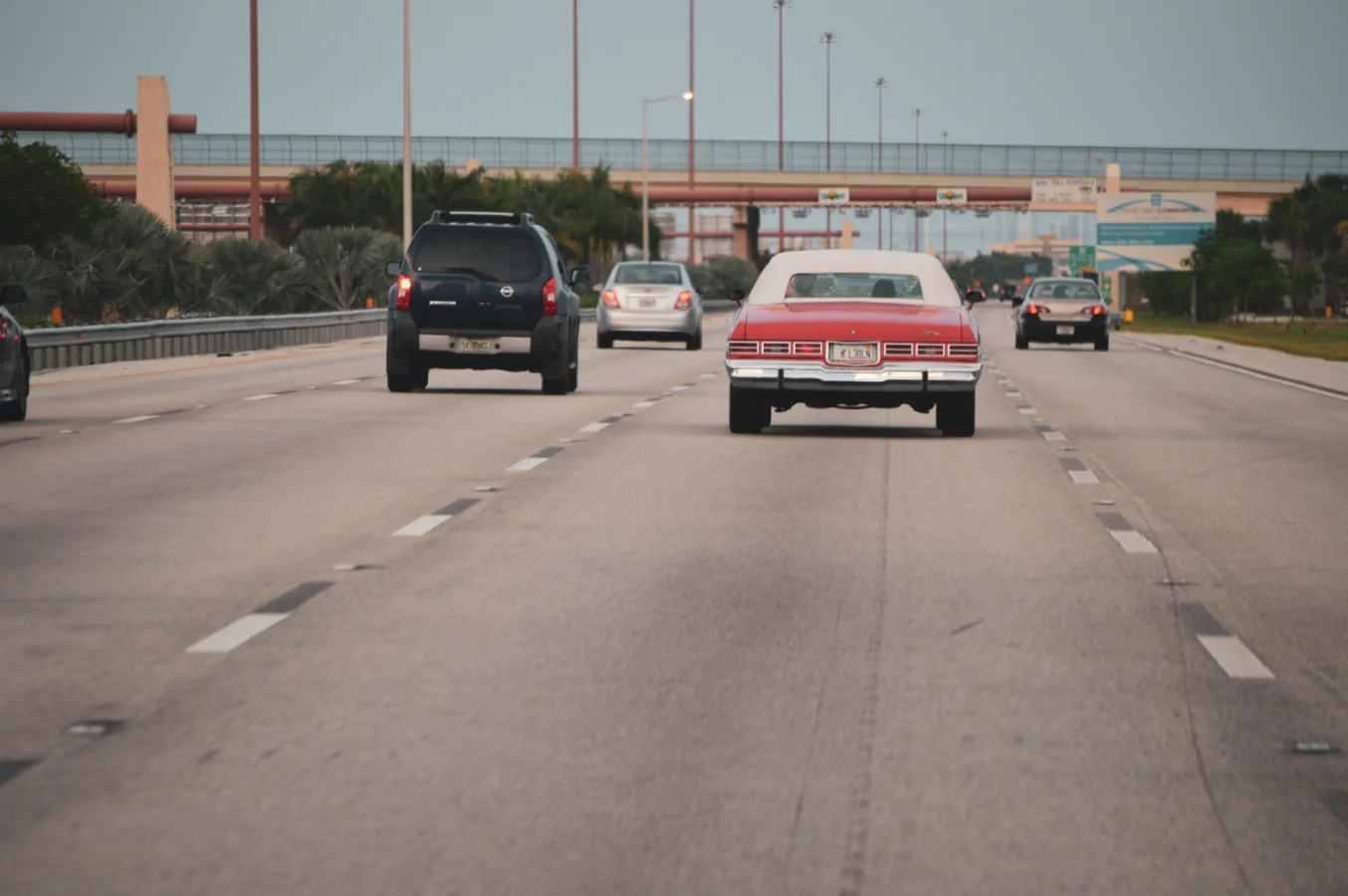
Photo: Caio Cezar / Pexels
This guide covers the Polish driving licence and the rules that apply in Poland. Legal status checked on 13 September 2026.
By car: 140 km/h on a motorway, 120 on a dual-carriageway expressway, 100 on a single-carriageway one, 80 with a trailer. Keep at least half your speed in metres (70 m at 140 km/h). No reversing, U-turns (on an expressway outside a junction) or stopping outside a MOP. Breakdown: triangle 100 m behind the car.
Who may enter a motorway or an expressway
Both roads are intended exclusively for motor vehicles, excluding quadricycles (art. 2 points 3 and 4 of the Road Traffic Act, Prawo o ruchu drogowym). The definition of a motorway adds a condition: the vehicle must be capable of reaching at least 40 km/h on a level, even carriageway, also with a trailer.
Bicycles, mopeds, e-scooters, agricultural tractors and pedestrians have no access there. Entering with a vehicle for which the road is not intended costs 250 zł (PLN) (fines tariff, item 156). The 40 km/h describes the technical capability of the vehicle, not the speed you drive at, and the question catalogue tests exactly that distinction.
How fast you may go: limit table for cars, trailers and buses
The limits are set out in art. 20(3)-(4) of the Road Traffic Act. They depend on the type of road and on what you are driving. Valid as of September 2026.
| Type of road | Car, motorcycle, lorry up to 3.5 t maximum permissible mass (DMC) | Vehicle combination (e.g. a car with a trailer) and other vehicles |
|---|---|---|
| Motorway | 140 km/h | 80 km/h |
| Dual-carriageway expressway | 120 km/h | 80 km/h |
| Single-carriageway expressway | 100 km/h | 80 km/h |
| Dual carriageway with at least two lanes in each direction | 100 km/h | 80 km/h |
| Other roads outside a built-up area | 90 km/h | 70 km/h |
A bus that meets additional technical conditions may travel at 100 km/h on a motorway and an expressway (art. 20(4)).
The most common trap is the trailer. A car with a trailer, even a light one, is a vehicle combination and drives at 80 km/h on a motorway (question 8898, answer A). You must not exceed this speed even when overtaking (question 13670: NO). Which trailers you may tow with category B is covered in our article on towing a trailer with category B, code 96 and B+E.
The second trap is the minimum speed. The Act does not set one. Art. 19(1)-(2) applies: you drive at a speed that lets you keep control of the vehicle and does not obstruct other traffic, no higher than the limit. Question 4613 has answer C (a safe speed, not obstructing others, no higher than the limit), and question 13058 answer A (a speed that ensures control of the vehicle, no higher than 140 km/h). Answers with the figure 40 or 60 km/h are distractors.
Fines and points for speeding on a motorway
The amounts come from the fines tariff (items 72-81), the points from the regulation on the register of drivers who breach the rules, in force from 3 June 2026. A repeat offence, meaning the same offence within 2 years, doubles the fine for exceeding the limit by more than 30 km/h.
| Over the limit by | Fine | Repeat offence | Points |
|---|---|---|---|
| up to 10 km/h | 50 zł | not doubled | 1 |
| 11-15 km/h | 100 zł | not doubled | 2 |
| 16-20 km/h | 200 zł | not doubled | 3 |
| 21-25 km/h | 300 zł | not doubled | 5 |
| 26-30 km/h | 400 zł | not doubled | 7 |
| 31-40 km/h | 800 zł | 1600 zł | 9 |
| 41-50 km/h | 1000 zł | 2000 zł | 11 |
| 51-60 km/h | 1500 zł | 3000 zł | 13 |
| 61-70 km/h | 2000 zł | 4000 zł | 14 |
| 71 km/h and more | 2500 zł | 5000 zł | 15 |
The 3-month licence suspension for more than 50 km/h over the limit applies in a built-up area and, from 3 March 2026, also on a single-carriageway two-way road outside one. A motorway and a dual-carriageway expressway are not such a road, so that sanction does not apply there. What remains is a fine of up to 2500 zł (5000 zł for a repeat offence) and 15 points. The procedure for having your licence taken is described in our article on speed limits and fines, and the consequences of exceeding the points limit in the piece on penalty points and losing your licence.
What gap you must keep: half your speed in metres
On a motorway and an expressway there is a numerical minimum gap to the vehicle ahead of you in the same lane: no fewer metres than half the figure of your speed in km/h (art. 19(3a)). The rule does not apply while overtaking.
| Speed | Minimum gap under the rule |
|---|---|
| 140 km/h | 70 m |
| 120 km/h | 60 m |
| 100 km/h | 50 m |
| 80 km/h | 40 m |
Too small a gap costs you 300-500 zł (item 153) and 5 points. The catalogue asks about this in question 13038: a car is travelling on a motorway at the maximum permitted speed, that is 140 km/h, so the minimum gap is 70 m (answer B).
In a tunnel longer than 500 m outside a built-up area, the minimum is 50 m for a vehicle up to 3.5 t DMC or a bus and 80 m for a vehicle combination and other vehicles (art. 19(4)). Question 3650 about a 600 m tunnel has answer A (no less than 50 m), and question 10398 about a 100 m gap has answer NO. The fine is also 300-500 zł (item 83). Where the half-your-speed figure comes from and how many metres you cover per second is explained in our article on braking distance, reaction time and a safe following distance.
Which lane to drive in and whether you may overtake on the right
Art. 16(4) requires you to drive as close as possible to the right-hand edge of the carriageway and to occupy only one lane. The left lane is for overtaking; after the manoeuvre you return to the right. Question 10499, whether on a motorway you may use any lane regardless of the situation, has answer NO. Straddling two lanes at once costs 150 zł (item 56) and 6 points.
Overtaking on the right is permitted on a one-way carriageway (art. 24(10)), and a motorway carriageway is one-way. So on a motorway and on a dual-carriageway expressway (a one-way carriageway with marked lanes) you may overtake on the right, provided the general safety conditions are met. On a single-carriageway expressway, where the carriageway is two-way, you may do so only when there are at least three lanes in your direction (art. 24(10) point 2). Questions 1480, 13664 and 3645 have answer YES.
Lorries with a DMC above 3.5 t (N2 and N3) and combinations longer than 7 m on a road with three or more lanes in one direction use only the two right-hand lanes (art. 16(2a), 6 points). On a road with only two lanes, an N2 or N3 lorry may not overtake a motor vehicle unless that vehicle is travelling much slower than the lorry's own limit (art. 24(13)-(14); catalogue 13622 NO, 13518 YES, 13519 NO, 13632 NO). Driving against the flow, meaning in the direction opposite to that required by the Act or the signs, costs 2000 zł (item 154) and 15 points.
What is not allowed: U-turns, reversing, towing, parking
| Ban | Legal basis | Fine | Points |
|---|---|---|---|
| U-turn on a motorway; on an expressway outside a junction or a place designated for it | art. 22(6) points 2-3 | 2000 zł (item 154) | 12 or 15 depending on classification |
| Reversing, even with the hazard lights on | art. 23(2) | 300 zł (item 155) | 10 |
| Stopping and parking outside a designated place (MOP, a motorway service area, or a car park) | art. 49(3) | 300 zł (item 157) | 1 |
| Failing to remove an immobilised vehicle from the carriageway and to warn others | art. 49(3) | 300 zł (item 158) | 1 |
A U-turn can be classified in two ways: breaching the ban on U-turns (12 points) or driving in the opposite direction (15 points), because after turning around you are driving against the flow. The points are not added together.
Reversing is banned without exception. Question 6203, whether you have the right to reverse on a motorway after switching on the hazard lights, has answer NO, and question 6208 confirms the ban with answer YES.
Towing on a motorway is allowed only by a vehicle designed for towing, and only to the nearest exit or service area (art. 31(2) point 5). You cannot tow a friend with your car even to the nearest exit: question 10080 has answer A (No). The provision names only the motorway, so this ban does not apply on an expressway.
The hard shoulder is not a place for a nap. A tired driver stops at a MOP: questions 8812 and 8852 (answer B) concern a lorry and a bus, but the rule in art. 49(3) is the same for everyone.
Breakdown or accident on a motorway: what to do step by step
On a motorway and an expressway you signal a stop caused by a breakdown or accident in every case (art. 50(1) point 1 and (2) point 1):
- Switch on the hazard lights. If the vehicle has none, switch on the position lights.
- Place the reflective warning triangle 100 m behind the vehicle, on the carriageway or the verge, depending on where the vehicle came to a stop.
- Keep signalling for the whole time you are stopped (para. 3; question 7167: YES).
- If possible, remove the vehicle from the carriageway and warn others (art. 49(3)).
- Call roadside assistance, because only a recovery vehicle may tow the car off the motorway.
Failing to signal, or signalling incorrectly, on a motorway or expressway carries a fine of 300 zł (item 159). On other roads outside a built-up area you place the triangle 30-50 m behind the vehicle, and the fine is 150 zł (item 181). The catalogue tests this difference: 6312 (100 m) YES, 6405 answer B (100 m), 7433 (50-70 m) NO, 6301 (30-50 m on an expressway) NO.
If while driving you feel short of breath, your arms go numb and you feel pain around the stomach, you do not carry on to the hospital. You carefully pull onto the hard shoulder, call the emergency medical services (Ratownictwo Medyczne) and undo your seat belt (question 6456, answer B). Your duties after an incident with another vehicle are described in our article on collisions and accidents.
Emergency corridor and zip merging
When heavy traffic makes it hard for an emergency vehicle to get through, you form an emergency corridor (korytarz życia, art. 9(2)). With two lanes in one direction, the driver in the left lane moves as close as possible to the left edge of the lane, and the driver in the right lane as close as possible to the right. With more than two lanes, the far left lane moves to the left and the others to the right. You must not drive along the corridor, and once the emergency vehicle has passed you return to your lane (para. 3). Driving along the emergency corridor costs 500-2500 zł (item 55) and 8 points.
Zip merging (jazda na suwak, art. 22(4a)-(4b)) applies when traffic slows considerably because a lane ends or is blocked by an obstacle: the driver in the adjacent lane, immediately before that point, lets in one vehicle from the ending lane. When two lanes end on both sides of the middle one, first one vehicle from the right, then one from the left.
Leaving the motorway and watching the road
You start braking for the exit only after entering the beginning of the deceleration lane, not in the motorway's running lane (question 10060, answer B; 10481 YES). Before the exit you move into the right-hand lane (10505 and 4155: YES). The signs for the end of a motorway, the end of an expressway and exits are tested in the catalogue with picture questions: 6036, 7291, 10160, 10161, 10165, 10183, 10511.
On a motorway you look far ahead and regularly check the road behind you in the mirrors (6366: C). You watch the whole carriageway and the verge in front of and behind the vehicle (10071: B). In fog on an expressway you keep your line by following the road markings that mark out the lanes (6356: A).
Cheat sheet: catalogue questions on motorways and expressways
| Number | What it asks | Answer |
|---|---|---|
| 4613 | required speed on a motorway | C: safe, not obstructing others, no higher than the limit |
| 13058 | speed on a motorway | A: ensuring control, no higher than 140 km/h |
| 8891, 8898 | car with a trailer (including a light one) on a motorway | A: 80 km/h |
| 13670 | whether with a light trailer you may exceed 80 km/h when overtaking | NO |
| 7249 | single-carriageway expressway, car | B: 100 km/h |
| 8876 | dual-carriageway expressway, car | B: 120 km/h |
| 13038 | minimum gap at 140 km/h | B: 70 m |
| 10499 | any lane regardless of the situation | NO |
| 1480, 13664, 3645 | overtaking on the right on a motorway and a dual-carriageway expressway (in the situation shown in the video) | YES |
| 6203, 6208 | reversing with the hazard lights on; ban on reversing | NO; YES |
| 10080 | towing with a car to the nearest exit | A: No |
| 6312, 6405 | triangle behind a broken-down car on a motorway | YES; B: 100 m |
| 7433, 6301 | triangle at 50-70 m or 30-50 m on an expressway | NO |
| 7167 | signalling for the whole time you are stopped | YES |
| 10060, 10481, 10505 | braking in the deceleration lane, moving to the right lane before the exit | B; YES; YES |
| 6366, 10071, 6356 | watching the road, keeping your line in fog | C; B; A |
| 6456 | feeling unwell while driving | B: hard shoulder, emergency medical services, undo the seat belt |
| 13593 | whether a 1 s delay in reacting on an expressway extends the stopping distance by tens of metres | YES |
You can practise all these questions, together with the rest of the Ministry of Infrastructure catalogue, on the list of category B exam questions. A practical tip for your first trip: once you are on the motorway, look at the speedometer, halve the number and leave that many metres to the car in front. At 140 km/h that is 70 m, far more than an eye used to city gaps would suggest.
Frequently asked questions
Is there a minimum speed on a motorway?
No. The 40 km/h condition in the definition of a motorway concerns the technical capability of the vehicle, not the speed you drive at. You drive at a speed that lets you keep control of the vehicle and does not obstruct other traffic, no higher than the limit (art. 19 of the Road Traffic Act).
How fast may you go with a light trailer on a motorway?
80 km/h, and the same on an expressway. A car with a trailer, even a light one up to 750 kg, is a vehicle combination. The catalogue adds that you must not exceed this speed even when overtaking (question 13670).
Do they take your licence for exceeding the limit by more than 50 km/h on a motorway?
The 3-month licence suspension applies in a built-up area and on a single-carriageway two-way road outside one. A motorway and a dual-carriageway expressway are not among them, but the fine stays: 1500 zł for 51-60 km/h (13 points), 2000 zł for 61-70 km/h (14 points), 2500 zł for more than 70 km/h (15 points); for a repeat offence within 2 years the amounts are doubled (as of September 2026).
May you overtake on the right on a motorway?
Yes. A motorway carriageway is one-way, and art. 24(10) permits overtaking on the right on a one-way carriageway. The same applies to a dual-carriageway expressway; on a single-carriageway one you need at least three lanes in your direction. The general conditions for safe overtaking still apply.
What should you do if your car breaks down on a motorway?
Switch on the hazard lights, place the triangle 100 m behind the vehicle and keep signalling for the whole time you are stopped. If you can, remove the vehicle from the carriageway. Only roadside assistance may tow the car away, to the nearest exit or a MOP (service area).
Can you tow a car on a motorway?
Not with a car, even to the nearest exit (question 10080). Only vehicles designed for towing may do it, and only to the nearest exit or service area. The provision applies to motorways, not expressways.
What is the fine for too small a gap on a motorway?
300-500 zł and 5 penalty points. The minimum gap is half your speed in metres: 70 m at 140 km/h, 60 m at 120 km/h, 50 m at 100 km/h. The rule does not apply while overtaking.
Related exam questions
- 4613What speed must you drive on a motorway?
- 13058At what speed is a passenger car permitted to travel on a motorway?
- 8898At what permissible speed are you allowed to travel when driving a passenger car pulling a light trailer on the highway?
- 13670Can you exceed 80 km/h when overtaking on the motorway with a passenger car and a light trailer?
- 7249At what maximum speed limit can you drive a passenger car of maximum permissible weight 3 t, on a single-carriage expressway?
- 8876You are driving a passenger car on dual carriage expressway. At what speed are permitted drive?
- 13038What is the minimum distance you must maintain from the vehicle in front of you if you are travelling on this road with your passenger car at the maximum permitted speed?
- 10499Are you allowed to drive in any lane on the motorway regardless of the traffic situation?
- 1480Are you allowed in this situation to continue overtaking from the right on the motorway?
- 6203Can you perform a reverse manoeuvre on a motorway if you turn on the vehicle's hazard lights?
- 6208Is it forbidden to perform a reverse manoeuvre on an express road?
- 10080Is it allowed to tow a passenger car on the highway to the nearest exit or rest area?
- 6312If you're involved in an accident on a motorway, are you obliged to signal the fact that your car is immobilized by placement of a warning triangle 100 m behind the car?
- 6405At what distance behind a broken-down passenger car, parked on a motorway, should you place a warning triangle?
- 7433Is switching on the emergency lights and placing a warning triangle at the distance of 50-70 m behind the vehicle the right way to indicate that it has broken-down on a motorway?
- 7167Are you obliged to indicate a break-down of a motor vehicle on the express road throughout the time the vehicle remains parked there?
- 10060You are travelling on the highway and intend to exit it. At what point do you start braking before the exit from the highway?
- 10481You are travelling on the highway and intend to exit it. Will you start braking when you enter the exit lane?
- 10505You intend to exit the motorway in the direction towards Pruszków. Should you change lanes to the right?
- 6366In what way should you observe your surroundings while driving on a motorway?
- 6456What should a person travelling on a highway do if they experience the following: shortness of breath, chills, numbness of the arms, pain around the stomach area and humming in the ears.
- 13593Could a 1-second delay in a driver's reaction at the speed limit on an expressway increase the stopping distance by several dozen meters?
- 8891You are driving a passenger vehicle with a trailer on the highway. What speed must you not exceed?
- 13664In this scenario, are you permitted to overtake on the right-hand side of the expressway?
- 3645Are you allowed in this situation to overtake the vehicle and then change lanes, if you want to leave the highway at the nearest exit?
- 6301Is it correct to place a warning triangle at a distance of 30-50 m behind the car, if the car breaks down on an express road?
- 10071Which of the following road elements should you observe when driving on the highway?
- 6356How can you maintain a proper course when driving on an express road in thick fog?
- 4155Should you start changing lanes in this situation, if you intend to leave the highway?
- 10398In this situation, when entering the tunnel, are you obliged to keep a distance of at least 100 meters from the preceding vehicle?
- 3650What distance from the preceding vehicle should you keep when driving a passenger car outside the built-up area in a tunnel 600 metres long?
- 13622In the situation depicted, when driving a lorry with a maximum gross weight exceeding 3.5 tonnes on the motorway, are you permitted to overtake a motor vehicle travelling at a speed slightly lower than yours?
- 13518In this situation, when driving a lorry with a maximum gross weight exceeding 3.5 tonnes on an expressway, are you prohibited from overtaking another motor vehicle travelling at a speed of 75 km/h?
- 13519In this situation, when driving a lorry with a maximum gross weight exceeding 3.5 tonnes on an expressway, are you allowed to overtake another motor vehicle travelling at 75 km/h?
- 13632When travelling on a dual carriageway with a lorry of maximum permissible weight 7 tonnes, are you permitted to overtake a vehicle that is not carrying out maintenance work and travelling at a slightly slower speed?
- 8812In which of these places can you stop a lorry on the highway when you feel tired?
- 8852In which of these places can you stop the bus when you feel tired, while driving on the highway?
Sources
- Ustawa z dnia 20 czerwca 1997 r. Prawo o ruchu drogowym (tekst jednolity Dz.U. 2024 poz. 1251) , Dziennik Ustaw (2024-08)
- Rozporządzenie Prezesa Rady Ministrów z dnia 30 grudnia 2021 r. zmieniające rozporządzenie w sprawie wysokości grzywien nakładanych w drodze mandatów karnych (taryfikator, Dz.U. 2021 poz. 2484) , Dziennik Ustaw (2021-12)
- Rozporządzenie Ministra Spraw Wewnętrznych i Administracji z dnia 29 maja 2026 r. w sprawie ewidencji kierujących pojazdami naruszających przepisy ruchu drogowego (Dz.U. 2026 poz. 724) , ELI (eli.gov.pl) (2026-06)
- Prawo jazdy: baza pytań egzaminacyjnych , gov.pl (2026-07)