
Pedestrian priority at crossings: rules and exam questions
A pedestrian on a crossing and a pedestrian stepping onto it have priority over a vehicle (except a tram), and the driver must slow down and give way. Breaking this rule carries a 1500 zł fine and 15 penalty points, and in the practical test such a mistake can stop the drive at once. Below: the rules, the three prohibitions at a crossing, a table of penalties and a cheat sheet of catalogue questions.
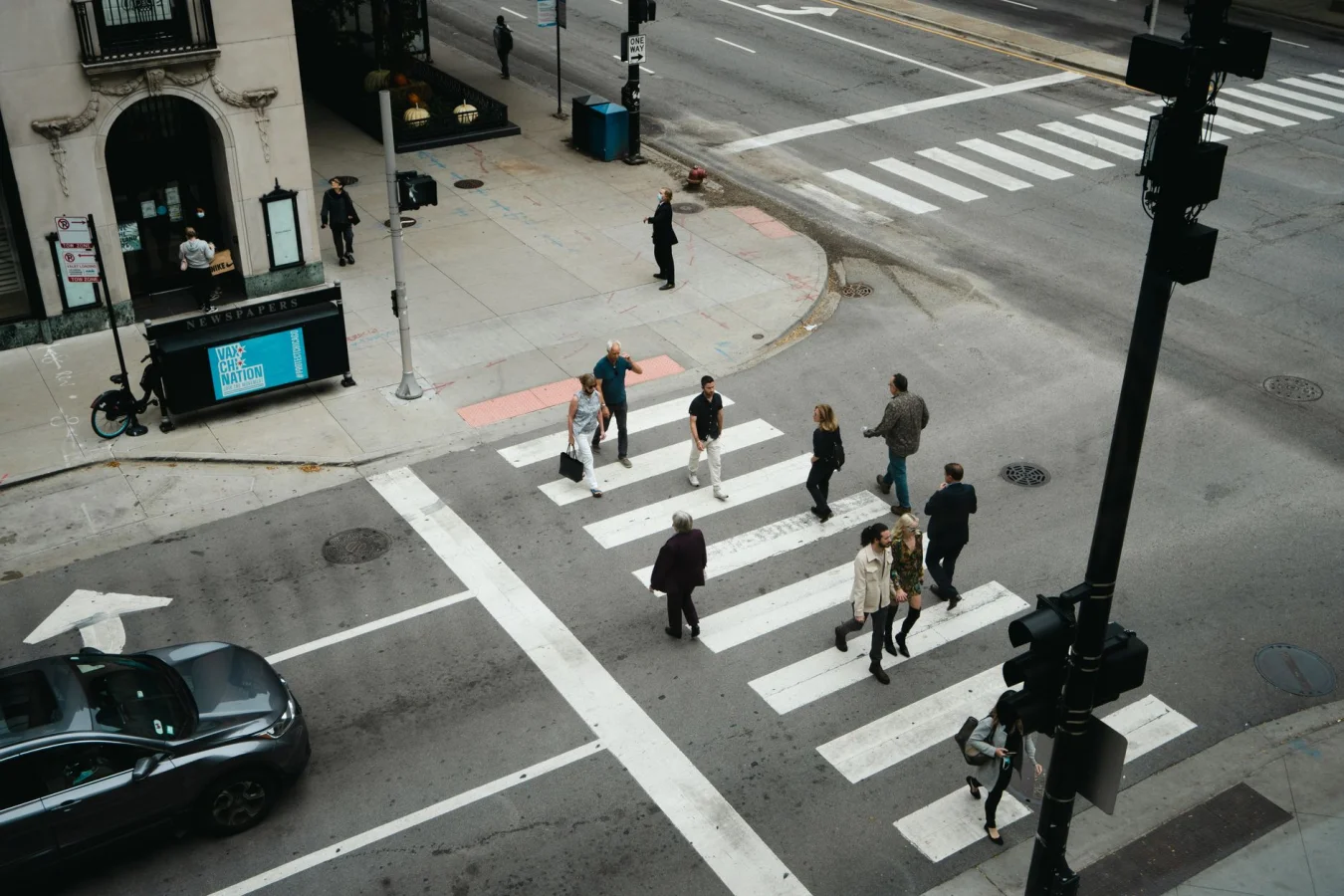
Photo: Otto Rascon / Pexels
This guide covers the Polish driving licence and the rules that apply in Poland. Legal status checked on 12 September 2026.
A pedestrian on a crossing and a pedestrian stepping onto it have priority over a vehicle; the pedestrian stepping on has no priority only over a tram. Approaching a crossing, the driver takes particular care, slows down and gives way to the pedestrian. Failing to give way carries a 1500 zł fine and 15 penalty points.
Who has priority at a crossing: the pedestrian on it and the pedestrian stepping onto it
Since 2021, art. 13(1a) of the Road Traffic Act (Prawo o ruchu drogowym) distinguishes two situations. A pedestrian who is already on the crossing has priority over every vehicle. A pedestrian who is only just stepping onto the crossing also has priority, with one exception: not over a tram.
Why the exception? The Act excludes trams expressly, and art. 26(1a) requires a tram driver to give way only to a pedestrian who is already on the crossing. The driver of a car, motorcycle or bicycle has no such exception. They brake both for the person on the crossing and for the one stepping onto it.
In practice, as you approach a crossing you watch not only the road but also the pavement on both sides. A person standing at the kerb who takes a step onto the crossing is already a pedestrian stepping on. You must give way to them. The catalogue checks this directly in question 13171 on a pedestrian stepping onto a crossing: the answer is YES.
What you must do when approaching a crossing
Art. 26(1) lists three duties of the driver. You perform them in order:
- You exercise particular care.
- You reduce speed so as not to endanger a pedestrian on the crossing or stepping onto it.
- You give way to the pedestrian.
The order is not accidental. You reduce speed in advance, not only once someone steps onto the crossing. That is exactly what the examiner watches on the route: whether you took your foot off the accelerator before the crossing, or drove up at full speed and braked at the last moment.
Towards one group of pedestrians the duty is stricter. For a disabled person using a special sign, or a person with visibly reduced mobility, you must stop the vehicle (art. 26(7)). Slowing down is not enough.
Turning into a side road, driving into a gateway and joining traffic
When turning into a side road, you give way to a pedestrian who is crossing, at the junction, the carriageway of the road you are entering (art. 26(2)). The catalogue asks about this in questions 6121 and 9554: you turn right, a pedestrian is crossing the carriageway of the side road, the answer is YES.
The same applies when driving into a gateway, a car park or a petrol station. When crossing a pedestrian path, that is the pavement, you drive slowly and give way to the pedestrian (para. 4). The same goes for a square with no separate carriageway (para. 5). In question 10369 you turn right into a gateway and the answer is YES.
The third situation is joining traffic, for example leaving a car park onto the road. Question 6094 checks whether you give way to a pedestrian who is outside a crossing. The answer: YES. When joining traffic you give way to everyone, including a pedestrian away from the crossing. Priority between vehicles is a separate topic, covered in our text on right of way at uncontrolled junctions and roundabouts.
Three prohibitions at a crossing: overtaking, passing, driving along
Art. 26(3) prohibits the driver from:
- overtaking a vehicle on a pedestrian crossing and directly before it (exception: a crossing where traffic is directed);
- passing a vehicle that was travelling in the same direction and stopped to give way to a pedestrian;
- driving along a pedestrian path or along a pedestrian crossing.
The most dangerous of these mistakes is passing. The car in the next lane is stopped before the crossing, and you cannot see who it stopped for. The pedestrian walks out from behind it straight under your wheels. The catalogue asks about this in question 7221 (can you pass a vehicle that stopped to let a pedestrian cross: NO).
Overtaking on a crossing is checked by questions 10229 and 13156, both with the answer NO. Question 13156 is tricky, because it concerns overtaking a vehicle travelling in the right-hand lane, that is a road with two lanes in one direction. The prohibition applies regardless of the number of lanes.
What duties the pedestrian has
Priority does not release the pedestrian from care. Art. 13 and 14 impose several duties on them:
- they exercise particular care and use the pedestrian crossing;
- away from a crossing they cross at a suggested crossing (przejście sugerowane), and elsewhere only when the nearest crossing is more than 100 m away (also at a junction closer than 100 m to a crossing), without priority and by the shortest route;
- they do not step onto the carriageway directly in front of a moving vehicle, including on a crossing, or from behind an obstacle that limits visibility;
- they do not run across the carriageway and do not stop on it unnecessarily;
- while stepping onto and crossing the carriageway they do not use a phone in a way that limits their observation of the situation (art. 14 point 8).
For a phone on the crossing the pedestrian also gets a fine from the fines tariff (the item under art. 97 of the Code of Petty Offences (Kodeks wykroczeń)). What a driver with a phone in hand faces is described in our article on the fine for using a phone while driving.
For you as a driver there is one conclusion. Even when the pedestrian breaks the rules, your duty to reduce speed and exercise particular care does not disappear.
Fines and points for failing to give way to a pedestrian
The basis for the penalties is art. 86b of the Code of Petty Offences. Anyone who, driving a motor vehicle on a public road, in a residential zone or in a traffic zone, fails to give way to a pedestrian, fails to stop for a disabled person, overtakes on a crossing where traffic is not directed, passes a vehicle stopped before a crossing or drives along a pedestrian path is liable to a fine of not less than 1500 zł (PLN). The court may additionally impose a driving ban, especially where the offender created a danger to the pedestrian (para. 3). A cyclist or the driver of another non-motor vehicle is liable to a fine or a reprimand (para. 2).
The fine amounts come from the fines tariff (regulation of 30 December 2021, items 34-39 and 42), and the points from the regulation on the register of drivers who breach the rules, in force from 3 June 2026. Repeat offending means the same offence within 2 years. As of September 2026.
| Offence | Fine | Repeat offence | Points |
|---|---|---|---|
| Failing to give way to a pedestrian on a crossing or stepping onto it | 1500 zł | 3000 zł | 15 |
| Passing a vehicle that stopped before a crossing | 1500 zł | 3000 zł | 15 |
| Overtaking on a crossing where traffic is not directed | fine of not less than 1500 zł | double (art. 38 para. 2 of the Code) | 15 |
| Failing to stop for a disabled person | fine of not less than 1500 zł | double (art. 38 para. 2 of the Code) | 15 |
| Failing to give way to a pedestrian when turning into a side road | 1500 zł | 3000 zł | 12 |
| Failing to give way to a pedestrian when reversing | 1500 zł | 3000 zł | 10 |
| Failing to give way to a pedestrian when crossing the pavement and on a square | 1500 zł | 3000 zł | 8 |
| Failing to give way to a pedestrian when joining traffic | 1500 zł | 3000 zł | 8 |
| Failing to give way to a pedestrian in a residential zone | 1500 zł | 3000 zł | 8 |
| Driving along a pedestrian path | fine of not less than 1500 zł | double (art. 38 para. 2 of the Code) | 8 |
For a young driver, 15 points is three quarters of the 20-point limit that applies in the first year after the first driving licence is issued. How the 20- and 24-point limits work and when points are cleared is described in our article on penalty points and losing your licence.
Which mistakes involving pedestrians stop the practical test
Table 9 of the annex to the regulation on driving tests (rozporządzenie w sprawie egzaminowania) lists behaviours that may result in the test being stopped. The examiner stops it when such behaviour directly endangered the life and health of road users (§ 16(1) point 2); then the "same task twice" rule does not apply, and the result is negative at once. Otherwise the mistake counts like any other in the task. The list includes almost all the situations from this text:
- failing to give way to a pedestrian on a crossing;
- failing to give way to a pedestrian when turning, when reversing, when joining traffic and in a residential zone;
- passing a vehicle stopped before a crossing;
- overtaking on a crossing.
The full list of reasons for stopping the test, and the situations in which the examiner will not run it at all, is in our article on the practical test day.
Cheat sheet of exam questions about pedestrians
Questions about pedestrians are mostly basic YES/NO questions. A basic question can be worth up to 3 points, and you may lose at most 6 out of 74, so one mistake can eat up half your margin. Below we give answers only where they follow directly from the rules described above. The remaining questions come with a photo or a video and require assessing a specific scene, and 3573 is a specialist question with three answers. Those we list without answers.
| Question number | What it asks | Answer |
|---|---|---|
| 13171, 13761 | whether you give way to a pedestrian stepping onto the crossing | YES |
| 6121, 9554 | whether, when turning right, you give way to a pedestrian | YES |
| 10369 | whether, when turning right into a gateway, you give way to a pedestrian | YES |
| 6094 | whether, when joining traffic, you give way to a pedestrian who is outside the crossing | YES |
| 7221 | whether you may pass a vehicle that stopped to let a pedestrian cross | NO |
| 10229 | whether overtaking is allowed on a pedestrian crossing | NO |
| 13156 | whether you may overtake, on a crossing, a vehicle travelling in the right-hand lane | NO |
| 2391, 6260 | whether in the situation shown you must let the pedestrian cross the carriageway | scene assessment |
| 7421 | whether in the situation shown you give way to the pedestrian | scene assessment |
| 7422, 13114 | whether in the situation shown you stop the vehicle to give way to the pedestrian | scene assessment |
| 8300 | whether you allow the pedestrian to leave the crossing freely | scene assessment |
| 13113 | whether you hold back from moving to give way to a pedestrian stepping onto the crossing | scene assessment |
| 3573 | how to behave as a witness to a pedestrian being hit (A, B, C) | specialist question |
The pattern is simple: if the question is about giving way to a pedestrian, the answer is YES; if it is about overtaking or passing at a crossing, the answer is NO. We have collected other traps from the test in our article on the most common mistakes in the theory test, and you can practise every question from the catalogue on the list of category B exam questions.
A practical tip for the route and for the test: at every crossing, take your foot off the accelerator before you judge whether anyone is stepping onto it. If a car in the next lane is stopped before the crossing, you stop too.
Frequently asked questions
Does a pedestrian standing at a crossing have priority?
The Act gives priority to a pedestrian on the crossing and one stepping onto it. Regardless of that, the driver must reduce speed when approaching a crossing, so treat a person standing at the crossing as a signal to slow down and be ready to stop.
Does a tram have to give way to a pedestrian stepping onto a crossing?
No. A pedestrian stepping onto a crossing has priority over a vehicle with the exception of a tram, and a tram driver gives way only to a pedestrian who is already on the crossing (art. 26(1a) of the Road Traffic Act).
How much is the fine for failing to give way to a pedestrian on a crossing?
1500 zł, and for a repeat offence within 2 years 3000 zł. Plus 15 penalty points. The basis is art. 86b of the Code of Petty Offences, which provides for a fine of not less than 1500 zł, and the court may impose a driving ban.
Is overtaking prohibited at every crossing?
The prohibition on overtaking on a crossing and directly before it does not cover a crossing where traffic is directed. At all other crossings overtaking is prohibited and means a fine of not less than 1500 zł and 15 points.
Can a pedestrian cross the road away from a crossing?
At a suggested crossing, and elsewhere only when the distance to the nearest crossing exceeds 100 m (also at a junction closer than 100 m to a crossing). They then cross without priority, by the shortest route, and may not step directly in front of a moving vehicle.
Does failing to give way to a pedestrian in the practical test mean an immediate negative result?
Yes. Failing to give way to a pedestrian on a crossing, when turning, reversing and joining traffic, as well as passing a vehicle stopped before a crossing and overtaking on a crossing, are in table 9 of the regulation on driving tests, so the examiner may stop the test when the behaviour directly endangered the life and health of road users.
Will a pedestrian get a fine for using a phone on a crossing?
Yes, if they use the phone in a way that limits their observation of the situation while stepping onto and crossing the carriageway (art. 14 point 8 of the Road Traffic Act). There is an item for pedestrians in the fines tariff.
Related exam questions
- 13171Are you obliged to give way to a pedestrian entering a crossing?
- 13761In this scenario, are you required to yield to a pedestrian who is about to step onto the pedestrian crossing?
- 6121Turning right in this situation, must you give right of way to the pedestrian?
- 9554Turning right in the presented situation, are you obliged to yield priority to pedestrians?
- 10369You intend to turn right into the gate. Are you obliged to yield the right of way to the pedestrian?
- 6094If you merge with traffic, should you give the right of way to a pedestrian who is not on a pedestrian crossing?
- 7221In this situation, can you bypass the car which has stopped in order to give way to a pedestrian?
- 10229Is overtaking allowed at the visible pedestrian crossing?
- 13156Are you permitted to overtake a vehicle in the right lane on a pedestrian crossing?
- 2391Are you obliged to allow the pedestrian to cross the road?
- 6260In this situation, are you obliged to allow the pedestrian to cross the road?
- 7421In this situation, are you obliged to give way to the pedestrian?
- 7422In this situation, are you obliged to stop the vehicle to let the pedestrian cross the street?
- 8300In this situation, should you allow a pedestrian to freely exit the pedestrian crossing?
- 13113In this situation, are you obliged to stop moving to yield the right of way to a pedestrian entering the crossing?
- 13114In this situation, are you obliged to stop your vehicle to yield the right of way to a pedestrian?
- 3573You witness a pedestrian being run down. How should you behave?
Sources
- Ustawa z dnia 20 czerwca 1997 r. Prawo o ruchu drogowym (tekst jednolity Dz.U. 2024 poz. 1251) , Dziennik Ustaw (2024-08)
- Ustawa z dnia 20 maja 1971 r. Kodeks wykroczeń (tekst jednolity Dz.U. 2025 poz. 734) , Dziennik Ustaw (2025-05)
- Rozporządzenie Prezesa Rady Ministrów z dnia 30 grudnia 2021 r. zmieniające rozporządzenie w sprawie wysokości grzywien nakładanych w drodze mandatów karnych (taryfikator, Dz.U. 2021 poz. 2484) , Dziennik Ustaw (2021-12)
- Rozporządzenie Ministra Spraw Wewnętrznych i Administracji z dnia 29 maja 2026 r. w sprawie ewidencji kierujących pojazdami naruszających przepisy ruchu drogowego (Dz.U. 2026 poz. 724) , ELI (eli.gov.pl) (2026-06)
- Rozporządzenie Ministra Infrastruktury z dnia 24 listopada 2023 r. w sprawie egzaminowania osób ubiegających się o uprawnienia do kierowania pojazdami (Dz.U. 2023 poz. 2659) , ELI (eli.gov.pl) (2023-12)