
Braking distance and speed: reaction time, gap and exam questions
The stopping distance is made up of the distance covered during the reaction time and the braking distance. The law gives no formula or table of metres, but the question catalogue tests a few relationships: 100 km/h is about 28 m per second, doubling the speed makes braking about four times longer, and a one-second delay is tens of metres. Below: these relationships, the gaps required by law and the traps in the questions.
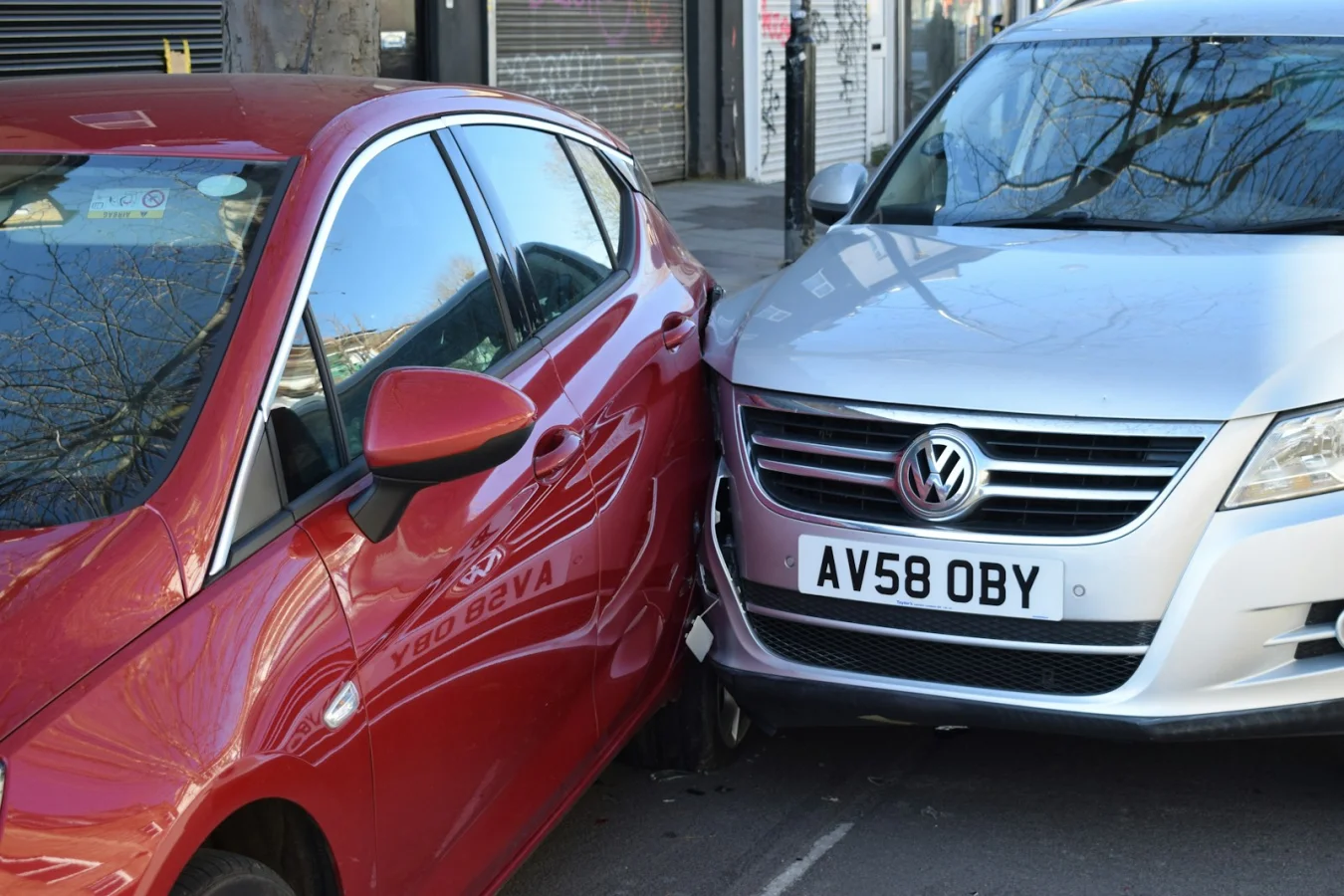
Photo: Usman Malik / Unsplash
This guide covers the Polish driving licence and the rules that apply in Poland. Legal status checked on 13 September 2026.
Stopping distance is reaction distance plus braking distance. At 100 km/h you cover about 28 m per second, and doubling your speed makes braking about four times longer. A gap in metres applies only on motorways, expressways, in tunnels and when overtaking two-wheelers (1 m); elsewhere it must rule out a collision.
What the stopping distance is made up of
The stopping distance is the sum of two sections. The first you cover during the reaction time: from the moment you notice an obstacle until the brakes start to work. The second is the braking distance, the section from the start of braking to a standstill. The first depends mainly on the driver, the second on speed, the road surface and the condition of the vehicle.
The Road Traffic Act (Prawo o ruchu drogowym) does not define the stopping distance or give a formula. The basis is art. 19(1): you drive at a speed that lets you keep control of the vehicle, taking into account the terrain, the condition and visibility of the road, the condition and load of the vehicle, the weather and the volume of traffic. In addition, art. 19(2) point 3 requires you to keep the gap needed to avoid a collision if the vehicle in front brakes or stops.
The question catalogue asks about factors with a direct influence on the length of the stopping distance. The answers are the driver's reaction time (questions 3651: A and 10056: C) and speed and the condition of the road surface (3652: B). The mass of the passengers, the mass of the vehicle and the amount of fuel are distractors in these questions.
How many metres you cover per second: 100 km/h is about 28 m
The simplest conversion in the catalogue: at 100 km/h a vehicle covers about 28 metres per second (question 13594, answer YES). It follows from arithmetic: 100 000 m divided by 3600 s. The same arithmetic gives the other values.
| Speed | About metres per second |
|---|---|
| 50 km/h | 14 m |
| 100 km/h | 28 m |
| 120 km/h | 33 m |
| 140 km/h | 39 m |
One second of delayed reaction at 120 km/h, the speed permitted on a dual-carriageway expressway, is about 33 m travelled without braking. That is why question 13593 (whether a 1-second delay in reacting at the speed permitted on an expressway can increase the stopping distance by tens of metres) has answer YES. The full limits for every type of road are in our article on speed limits and fines.
Twice as fast, four times as long
The braking distance does not grow in proportion to speed. Doubling the speed makes it roughly four times longer. The catalogue asks about this in several variants: question 3634 (how doubling the speed affects the length of the braking distance) has answer B (four times), question 10059 answer C (4 times), question 6346 answer A, and 8995 answer A (the braking distance gets longer as speed increases).
We do not give our own tables of metres for specific speeds here, because there are none in the Act or the catalogue. For the exam the relationship is enough: doubling the speed means about four times longer braking, and on top of that comes the reaction distance, which grows in proportion to speed.
What lengthens the stopping distance: table of factors
| Factor | What it does to the stopping distance | Catalogue question |
|---|---|---|
| Driving speed | doubling the speed means about four times longer braking | 8957: A, 3634: B |
| Driver's reaction time | every second is a dozen or several dozen metres without braking | 3651: A, 10056: C, 13593: YES |
| Visibility and complexity of the traffic situation | lengthen the perception and reaction time | 8972: B |
| Icy road surface | the longest braking distance of all conditions | 7461: C |
| Leaves on the carriageway | lengthen the braking distance | 7458: B |
| Rain | the risk of skidding is greatest in the initial phase of rainfall | 4362: A |
| Condition of the road surface in general | you adjust speed and gap to the surface | 12890: B |
| Condition of the brakes | directly affects the stopping distance | 8961: B |
Question 7461 (in which conditions the braking distance is longest) has three answers: a dry, a wet and an icy surface. The correct one is C, icy.
Reaction time: what lengthens it and how to shorten it
The total perception and reaction time is affected by visibility on the road and the complexity of the traffic situation (question 8972, answer B). The more that is going on around you and the worse the visibility, the later you spot a hazard and the further you travel before you start braking.
The simplest way to lengthen your reaction time is a phone in your hand. That is a separate offence with a 500 zł (PLN) fine and 12 points (as of September 2026), which we describe in our article on using a phone at the wheel. Tiredness works in a similar way, though the rules give no figures here: treat it as practical advice and plan breaks before you start nodding off.
You also shorten your reaction time by looking far ahead of the bonnet and by anticipating. When you see cars braking two vehicles ahead, you lift off the accelerator before the brake lights come on directly in front of you.
Emergency braking with and without ABS
In a car with ABS you brake in an emergency quickly and hard, pressing the pedal all the way down, and you do not release it when the system kicks in and the pedal starts to pulse. The catalogue tests this in questions 6379: A, 7710: A, 3858: B, 3859: A and 6338: C (the shortest braking distance with ABS: pressing the pedal all the way down).
ABS prevents the wheels from locking, keeps the car steerable and helps you keep control while braking (4495: A, 7463: B, 3860: A, 6339: A). It does not shorten the braking distance in all conditions. Question 6337 on the function of ABS has answer C (it makes it easier to steer around obstacles while braking); answer A (it shortens the braking distance in all conditions) is a distractor.
Without ABS, braking too hard locks the wheels and leads to a loss of steering control (3857: B). If the ABS fails on a slippery surface, you brake in pulses (10054: A). How ABS, ESP and the other systems work is explained in our article on car safety systems.
What gap the rules require: table
On an ordinary road the rule gives no figure. The gap must be sufficient to avoid a collision if the vehicle in front brakes or stops (art. 19(2) point 3), and you set it according to the speed of the vehicles (10034: A, 6351: A). Question 13042 picks exactly that wording (answer B), and the answers with a number of metres at 60 km/h or with any gap you like are distractors. A numerical minimum exists in only a few places.
| Situation | Minimum gap | Legal basis | Fine and points | Question |
|---|---|---|---|---|
| Motorway and expressway, same lane | half your speed in metres (140 km/h is 70 m, 100 km/h is 50 m); does not apply when overtaking | art. 19(3a) | 300-500 zł, 5 points | 13038: B |
| Tunnel longer than 500 m outside a built-up area | 50 m (vehicle up to 3.5 t maximum permissible mass, DMC, or a bus), 80 m (vehicle combination and other vehicles) | art. 19(4) | 300-500 zł, 5 points | 3650: A |
| Traffic jam in a tunnel | 5 m | art. 47a | 100 zł | 6347: B |
| Overtaking a bicycle, moped, motorcycle, e-scooter, personal transporter (UTO) or a column of pedestrians | at least 1 m | art. 24(2) | 300 zł for overtaking without a safe gap | 3629: C, 8979: A, 1068: YES, 6270: NO |
| Vehicle with an individual speed restriction and a combination longer than 7 m outside a built-up area on a two-way carriageway with two lanes | a gap for an overtaking vehicle to pull into | art. 19(3) | 200 zł | no question in the cheat sheet |
For too small a gap on an ordinary road the fines tariff has no separate amount. The items cover motorways, expressways and tunnels (items 153 and 83), the gap for overtaking vehicles (item 82) and overtaking without a safe gap (item 91). The details of the rules on motorways are collected in our article on driving on motorways and expressways.
Two questions on lateral clearance go beyond numbers. When passing parked cars you allow for a door being opened (8220: YES), and when passing a drunk cyclist you increase the gap (3367: YES).
The two-second rule: advice, not law
The two-second rule is practical advice that appears neither in the Act nor in the catalogue. You pick a reference point, say a post or a sign, and count how much time passes from the moment the vehicle in front passes it until you pass it yourself. If it is less than two seconds, you increase the gap. Counting takes a moment, and after a few days you do it by reflex, without looking at a clock.
The arithmetic shows that the rule is more cautious than the law. At 100 km/h you cover about 28 m per second, so two seconds is about 56 m. The statutory minimum on a motorway and an expressway at that speed is 50 m. On a wet or icy road you increase the gap, because the braking distance grows and the rules require you to adjust speed and gap to the conditions.
Traps in the questions and a cheat sheet with answers
Three types of distractor come back regularly in this topic:
- The mass of the passengers, the mass of the vehicle and the amount of fuel as a factor directly affecting the stopping distance (3651, 3652, 10056). The correct answers are reaction time, and speed and the condition of the road surface.
- ABS supposedly shortening the braking distance in all conditions (6337). ABS keeps the car steerable, and the shortest distance with ABS comes from pressing the pedal all the way down (6338).
- A gap in metres on an ordinary road (13042). A figure for the gap to the vehicle in front applies only on a motorway, an expressway and in a tunnel; elsewhere the gap must be enough to avoid a collision. A separate figure is the 1 m of lateral clearance when overtaking two-wheelers and a column of pedestrians (art. 24(2)).
| Number | What it asks | Answer |
|---|---|---|
| 13594 | whether 100 km/h is about 28 m per second | YES |
| 13593 | whether a 1 s delay in reacting on an expressway extends the stopping distance by tens of metres | YES |
| 3634, 10059 | effect of doubling the speed on the braking distance | B: four times; C: 4 times |
| 6346, 8995 | how the braking distance depends on speed | A; A |
| 3651, 10056 | factor directly affecting the stopping distance: reaction time | A; C |
| 3652 | direct factor: speed and the condition of the road surface | B |
| 8957, 8961 | driving speed; condition of the brakes | A; B |
| 8972 | what affects the perception and reaction time | B: visibility and complexity of the situation |
| 7461, 7458, 12890, 4362 | ice, leaves, condition of the surface, start of rainfall | C; B; B; A |
| 6379, 7710, 3858, 6338 | emergency braking with ABS: quickly, hard, pedal all the way down | A; A; B; C |
| 6337, 4495 | function of ABS: steering control, not a shorter distance in all conditions | C; A |
| 3857, 10054 | without ABS: loss of steering control; if the ABS fails, braking in pulses | B; A |
| 10034, 6351, 13042 | gap according to speed; no figure on an ordinary road | A; A; B |
| 13038, 3650, 6347 | 70 m on a motorway, 50 m in a 600 m tunnel, 5 m in a jam in a tunnel | B; A; B |
| 8979, 3629, 1068, 6270 | 1 m when overtaking two-wheelers | A; C; YES; NO |
| 8220, 3367 | doors of parked cars; drunk cyclist | YES; YES |
The pattern of mistakes that cost points in the theory test is described in our article on the most common mistakes in the theory test. You can practise all the questions on this topic on the list of category B questions, and under exam conditions in the category B mock exam. A practical tip for the road: when the car in front passes a sign, start counting; if you pass it before two, just lift off the accelerator.
Frequently asked questions
What is the braking distance at 50 km/h?
Neither the Act nor the question catalogue gives metres for a specific speed. For the exam the relationship is enough: doubling the speed makes the braking distance about four times longer, and at 50 km/h you cover about 14 m per second, so every second of reaction is another 14 m.
What is the difference between braking distance and stopping distance?
The braking distance is the section from pressing the brake to a standstill. The stopping distance is longer, because it adds the section travelled during the driver's reaction time, before the brakes start to work.
What gap do you have to keep from the car in front?
On an ordinary road, one that lets you avoid a collision if the vehicle in front brakes (art. 19(2) point 3). A figure applies on a motorway and an expressway (half your speed in metres), in a tunnel longer than 500 m (50 m or 80 m) and in a traffic jam in a tunnel (5 m). When overtaking a bicycle, moped, motorcycle, e-scooter or a column of pedestrians the lateral clearance is at least 1 m.
Does ABS shorten the braking distance?
Not in all conditions, and that is how the distractor in question 6337 is worded. ABS prevents the wheels from locking and keeps the car steerable, so you can steer around an obstacle while braking. With ABS you brake in an emergency by pressing the pedal all the way down.
How do you brake in an emergency in a car without ABS?
Braking too hard without ABS locks the wheels and takes away steering control (question 3857). On a slippery surface, including when the ABS fails, the catalogue indicates braking in pulses (question 10054).
Is the two-second rule in the law?
No, it is practical advice. At 100 km/h two seconds is about 56 m, more than the statutory 50 m on a motorway and an expressway. In rain and on ice you increase the gap, because the rules require you to adjust it to the conditions.
What is the fine for too small a gap?
On a motorway, an expressway and in a tunnel longer than 500 m outside a built-up area 300-500 zł and 5 points, in a traffic jam in a tunnel 100 zł. For overtaking without a safe gap 300 zł (as of September 2026). On an ordinary road the fines tariff has no separate item for the gap alone.
Related exam questions
- 13594Does a vehicle travelling at 100 km/h cover approximately 28 metres per second?
- 13593Could a 1-second delay in a driver's reaction at the speed limit on an expressway increase the stopping distance by several dozen meters?
- 3634In what way does doubling of the speed of a passenger car influence the braking distance?
- 6346Approximately, by how much does the braking distance increase if speed is doubled?
- 10059By how much does the braking distance increase, if you double the speed?
- 8995How does the braking distance of the vehicle change dependent on the speed increase?
- 3651Which of the following factors has direct influence on the stopping distance of the passenger car?
- 10056Which of these factors has a direct impact on the total stopping distance of a passenger car?
- 3652Which of the following factors has direct influence on the stopping distance of the passenger car?
- 8961Which of these factors has a direct influence on the braking distance?
- 8957Which of these factors has a direct influence on the braking distance?
- 8972What factors have an influence on the total perception and reaction time of a vehicle driver?
- 7461The braking distance is the longest on:
- 7458Can leaves lying on a roadway have an impact on the braking distance of a vehicle?
- 12890Should speed and distance from other road users be adapted to the road surface condition?
- 4362While driving a car in the rain the risk of skidding is:
- 6379In what way should you brake in an emergency situation, if the vehicle is equipped with anti-lock braking system (ABS)?
- 7710Which of the following emergency braking techniques should be applied in a passenger car fitted with ABS?
- 3858Which of the following ways of braking in a passenger car fitted with the ABS is the most effective?
- 6338How can the shortest braking distance of a car equipped with the anti-lock braking system (ABS) be achieved?
- 6337What is the function of the anti-lock braking system (ABS)?
- 4495What is the purpose of using the ABS system in a passenger car?
- 3857What might be the result of too strong braking of a passenger car not fitted with the ABS?
- 10054Which braking method do you apply in the event of an ABS failure on a slippery surface?
- 10034Which of the values below should you take into account when establishing the distance between the vehicle in front?
- 6351What does a safe distance you should keep while driving behind another car depend on?
- 13042What distance from the preceding vehicle should you maintain when driving a passenger car on this road?
- 13038What is the minimum distance you must maintain from the vehicle in front of you if you are travelling on this road with your passenger car at the maximum permitted speed?
- 3650What distance from the preceding vehicle should you keep when driving a passenger car outside the built-up area in a tunnel 600 metres long?
- 6347What minimum distance should you keep from the car in front of you when stuck in a traffic jam in a tunel?
- 8979What distance should you maintain when overtaking a cyclist or a moped?
- 3629What distance should you keep when overtaking a motorcycle?
- 1068Are you obliged to maintain a distance of at least 1 metre from the overtaken cyclist in this situation?
- 8220When assuming a safe distance from parked vehicles, should you take into account the possibility of one of the vehicles' doors opening?
- 3367Should you increase the distance from the drunk cyclist when passing him?
Sources
- Ustawa z dnia 20 czerwca 1997 r. Prawo o ruchu drogowym (tekst jednolity Dz.U. 2024 poz. 1251) , ELI (eli.gov.pl) (2024-08)
- Prawo jazdy: baza pytań egzaminacyjnych , gov.pl (2026-07)
- Rozporządzenie Prezesa Rady Ministrów z dnia 30 grudnia 2021 r. zmieniające rozporządzenie w sprawie wysokości grzywien nakładanych w drodze mandatów karnych (taryfikator, Dz.U. 2021 poz. 2484) , Dziennik Ustaw (2021-12)
- Rozporządzenie Ministra Spraw Wewnętrznych i Administracji z dnia 29 maja 2026 r. w sprawie ewidencji kierujących pojazdami naruszających przepisy ruchu drogowego (Dz.U. 2026 poz. 724) , Dziennik Ustaw (2026-06)