
Parking on the pavement and no-stopping rules: distances and fines
You may stop on the pavement only if the conditions in art. 47 of the Road Traffic Act are met: a car of up to 2.5 t, a pavement at least 1.5 m wide and a clear path for pedestrians. Art. 49 lists the places covered by stopping and parking bans, with distances of 10 m and 15 m. Below are all the conditions, a table of bans, fines from the tariff, penalty points and a cheat sheet of exam questions.
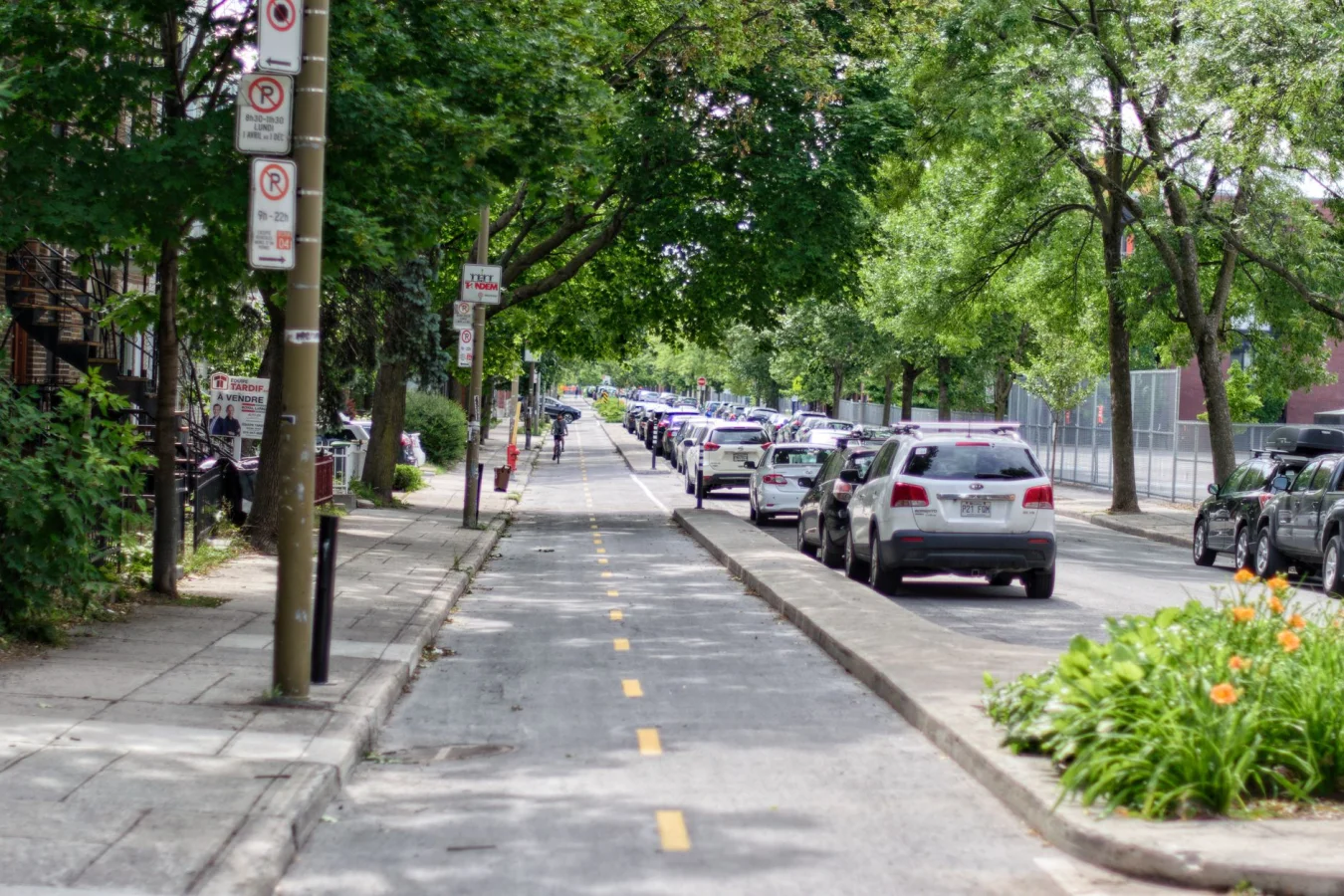
Photo: Yvon Gallant / Pexels
This guide covers the Polish driving licence and the rules that apply in Poland. Legal status checked on 12 September 2026.
You may stop a car up to 2.5 t on the pavement where no stopping or parking ban applies, the pavement is at least 1.5 m wide and pedestrians can get past. Stopping is banned, for example, within 10 m of a junction or pedestrian crossing and within 15 m of a bus stop. Fines: 100-300 zł.
Stopping and parking: what the rules mean
The Road Traffic Act (Prawo o ruchu drogowym) distinguishes between stopping and parking, and some bans apply to only one of them. The Act counts it in minutes (art. 2, points 29-30): stopping is immobilising the vehicle for reasons other than traffic conditions or rules, for no longer than 1 minute (and also any immobilisation caused by those conditions, for example in a traffic jam), while parking is immobilising the vehicle for longer than 1 minute. That one minute sometimes comes up as an exam question. A no-stopping rule is stricter, because if you cannot stop, you cannot park either. Where only a no-parking rule applies, the Act does not forbid stopping itself.
The general rule is in art. 46. Stopping and parking are allowed only in a place where the vehicle is visible from a sufficient distance and does not endanger safety or obstruct traffic (para. 1). On the carriageway you stop as close to the edge as possible and parallel to it (para. 2). Outside a built-up area, when parking you pull off the carriageway where possible (para. 3). After leaving the car you secure it against being started by an unauthorised person (para. 5).
Several entries in the fines tariff are linked to that last rule, and we describe them alongside the fine for a snow-covered car: leaving the engine running while parked in a built-up area costs 100 zł (PLN), and walking away from a vehicle with the engine running 50 zł.
When you may stop on the pavement: 2.5 t, 1.5 m and a clear path
Art. 47(1) allows a car with a permissible total mass (DMC) of up to 2.5 t to stand with the wheels of one side or of the front axle on the pavement (a road for pedestrians). Three conditions must be met at the same time:
- no stopping or parking ban applies on that section of road;
- the pavement is at least 1.5 m wide and the vehicle will not obstruct pedestrians;
- a vehicle standing with its front axle on the pavement does not block traffic on the carriageway.
Para. 2 goes a step further. A whole passenger car, motorcycle, moped or cycle cart (wózek rowerowy) may stand on the pavement at the edge of the carriageway if conditions 1 and 2 are met (no ban and at least 1.5 m for pedestrians). Any other vehicle with a DMC of up to 2.5 t (for example a van) may be parked entirely on the pavement only in a place marked with signs.
Bicycles, e-scooters and personal transporters have their own provision (para. 3): you leave them in a place designated for that, and if there is none, as far from the carriageway as possible and parallel to it. Where you may ride an e-scooter and from what age is described in our article on e-scooters.
Two traps from the question catalogue. First, 1.5 m is the minimum pavement width, but that is not the end of the check: if pedestrians find it hard to get past after you park, parking is prohibited (question 6173, answer NO). Second, a no-stopping sign also covers the pavement next to that carriageway (question 9379, answer YES). Whether pedestrians must be left a path at least 1.5 m wide is tested in question 6166 (YES).
Where you must not stop: table of distances from art. 49(1)
A stopping ban means you may neither pull up for a moment nor park there. The Act lists these places in art. 49(1).
| Place | Scope of the stopping ban |
|---|---|
| Level crossing, tram crossing, junction | on them and within 10 m of them |
| Pedestrian crossing and cycle crossing | on them and within 10 m before them; on a two-way road with two lanes also within 10 m after them |
| Tunnel, bridge, flyover | along their entire length |
| Solid line | alongside it, when this forces other drivers to drive over it |
| Carriageway edge line | next to a broken line, and on the carriageway and hard shoulder next to a solid line |
| Road sign or signal | within 10 m before it, if the vehicle obscures it |
| Left edge of the carriageway | stopping at the left edge is banned; exception: in a built-up area on a one-way road or on a two-way carriageway with light traffic (art. 49(1)(7)) |
| Central reservation (strip between carriageways) | on the whole strip |
| Bus or tram stop | within 15 m of the stop post or sign, and along the whole length of a bay |
| Traffic island | within 15 m of the island, when the carriageway on its right has one lane |
| Cycle path, cycle lane, cycle box | ban for all vehicles except bicycles |
Two numbers are worth keeping in mind for the exam: 10 m and 15 m. Ten metres applies to junctions, level and tram crossings, pedestrian crossings and signs. Fifteen metres applies to stops and islands. The catalogue tests this difference directly: stopping 11 m from a stop is too close, because 15 m is required (question 7374, answer NO).
Parking bans: gateways, level crossings, residential zones and motorways
Art. 49(2) lists places where you may stop but may not park:
- a place that obstructs entry or exit, for example in front of a gateway, garage, car park or parking bay (question 3548 on a gateway entrance: NO);
- a place that obstructs access to another vehicle;
- before and after a level crossing, on the section from the crossing to the post with one stripe;
- a residential zone outside designated places;
- a built-up area for a vehicle with a DMC above 16 t or longer than 12 m, outside designated car parks.
Motorways and expressways have a separate rule (para. 3): stopping and parking are allowed only in designated places. Pulling onto the hard shoulder because you are tired or want to take a call is not a designated place. Speed limits on these roads and fines for exceeding them are set out in our article on speed limits in Poland.
If you leave the car parked in conditions of insufficient visibility, a lighting duty applies: position lights or parking lights, unless the place is lit or you are standing off the carriageway and hard shoulder. The details from art. 52 are in our text on car lights.
How much is the fine for bad parking: table from the tariff
The amounts come from the fines tariff (the regulation of 30 December 2021, entries 157 and 160-179). As of September 2026.
| Offence | Fine | Entry |
|---|---|---|
| Stopping or parking on a motorway or expressway outside a designated place | 300 zł | 157 |
| Stopping or parking in a place where the vehicle is not visible or obstructs traffic | 100-300 zł | 160 |
| Stopping not at the edge of the carriageway or not parallel to it | 100 zł | 161 |
| Parking on the carriageway outside a built-up area when it was possible to stop off it | 150-300 zł | 162 |
| Breaching the conditions for parking on the pavement | 100 zł | 163 |
| Stopping on a level crossing, tram crossing or junction, or within 10 m of them | 300 zł | 165 |
| Stopping on a pedestrian crossing or cycle crossing, or within 10 m of them | 100-300 zł | 166 |
| Stopping in a tunnel, on a bridge or on a flyover | 200 zł | 167 |
| Stopping alongside a solid line | 100 zł | 168 |
| Stopping next to an edge line | 100 zł | 169 |
| Stopping before a sign or signal that the vehicle obscures | 100 zł | 170 |
| Stopping at the left edge of the carriageway | 100 zł | 171 |
| Stopping on the central reservation | 100 zł | 172 |
| Stopping within 15 m of a stop | 100 zł | 173 |
| Stopping at a traffic island | 100 zł | 174 |
| Stopping on a cycle path | 100 zł | 175 |
| Parking in front of a gateway, garage or car park | 100 zł | 176 |
| Parking that blocks access to another vehicle | 100 zł | 177 |
| Parking at a level crossing | 100 zł | 178 |
| Parking in a residential zone outside a designated place | 100 zł | 179 |
The highest amounts are for junctions, crossings and motorways (300 zł). The typical mistake on a housing estate, parking in front of someone else's gateway or in a residential zone outside a designated place, costs 100 zł. We do not cover towing or paid parking zones here, because other rules govern them.
Penalty points: 5 points for three offences, 1 point for the rest
The regulation on the register of drivers who breach road traffic rules, in force since 3 June 2026, assigns points to only three offences in this area:
| Offence | Points | Code |
|---|---|---|
| Stopping on a pedestrian crossing or cycle crossing and within 10 m before them (and after them on a two-way road with two lanes) | 5 | H 18 |
| Stopping on a level crossing, tram crossing or junction and within 10 m of them | 5 | H 19 |
| Stopping in a tunnel, on a bridge or on a flyover | 5 | H 20 |
Every other breach of the conditions and bans on stopping or parking (pavement, stop, gateway, residential zone, motorway) has code H 28 and 1 point; when it coincides with H 18-H 20, points are counted only once, for the more serious offence. What the three pointed entries have in common is a place where a standing vehicle blocks the view of other road users: pedestrians at a crossing, drivers at a junction, everyone in a tunnel.
How the question catalogue tests stopping and parking: cheat sheet
Most questions on this topic are YES/NO questions with a photo or with a specific number. The answers in line with the rules:
| Question number | What it asks | Answer |
|---|---|---|
| 6166 | whether pedestrians must be left a path at least 1.5 m wide on the pavement | YES |
| 6172 | whether pedestrians must be left a path at least 2.5 m wide on the pavement | NO |
| 6173 | parking on the pavement when it obstructs pedestrians | NO |
| 9379 | whether a no-stopping rule also covers the pavement | YES |
| 7374 | stopping 11 m from a bus stop | NO, because 15 m is required |
| 6282 | stopping or parking in the place shown | NO |
| 1592 | stopping or parking in the place shown | NO |
| 3548 | parking in front of a gateway entrance | NO |
Questions 6281, 9366, 9372, 9696, 6160 and 7317 also concern stopping and parking. You will find them all on the list of category B exam questions, and each has its own page, for example question 7374 on stopping 11 m from a bus stop.
A practical tip for your first months at the wheel: before you switch off the engine, count your steps. About ten long strides from a crossing or junction, and fifteen from a bus stop post, is a simple way to check the distance without a tape measure. Judge the pavement by whether a pushchair and someone walking beside it would still fit.
Frequently asked questions
Can you park a whole car on the pavement?
A passenger car, yes, at the edge of the carriageway and provided the conditions in art. 47 are met: no stopping or parking ban, a pavement at least 1.5 m wide and a clear path for pedestrians. Any other vehicle of up to 2.5 t may stand entirely on the pavement only in a place marked with signs.
How many metres from a pedestrian crossing can you stop?
At least 10 m before the crossing, and on a two-way road with two lanes also 10 m after it. The offence costs a fine of 100-300 zł and 5 penalty points.
How many metres from a bus stop does the stopping ban apply?
15 m from the stop post or sign, and if the stop has a bay, the ban covers its whole length. The fine is 100 zł and 1 penalty point (code H 28).
Does a no-stopping sign also apply on the pavement?
Yes. The exam question catalogue tests this in question 9379, with the answer YES. The absence of a stopping or parking ban on a given section is the first condition for parking on the pavement under art. 47.
Do you get penalty points for bad parking?
Yes. 5 points each for three offences: stopping on a pedestrian or cycle crossing and 10 m before them, on a level crossing, tram crossing or junction and 10 m from them, and in a tunnel, on a bridge or on a flyover (codes H 18-H 20). Every other breach of the conditions or bans on stopping and parking is 1 point (code H 28) plus a fine.
Where should you leave an e-scooter?
In a place designated for it. If there is none, put it as far from the carriageway as possible and parallel to it (art. 47(3)). The same rule applies to bicycles and personal transporters.
Can you park anywhere in a residential zone?
No. In a residential zone parking is allowed only in designated places (art. 49(2)). For parking outside such a place the tariff provides 100 zł (entry 179).
Related exam questions
- 6166If you stop a car on a sidewalk, do you have to allow a 1.5 m wide passage for pedestrians?
- 6172If you stop a car on a sidewalk, do you have to ensure that pedestrians have a passage of at least 2.5 m wide?
- 6173Can you stop a car on a sidewalk, leaving a passage of 2 m, if this causes an obstacle to pedestrian traffic?
- 9379In the presented situation, does the stop prohibition apply also to the pavement?
- 7374In this situation, are you allowed to park the vehicle on the pavement on the right side at the distance of 11 meters from the sign indicating a bus stop?
- 6282In this situation, can you park the car on the right side, on the sidewalk immediately in front of the railway crossing?
- 1592Are you allowed to park the vehicle on the pavement in front of these signs?
- 3548Is it allowed to stopover at the entry to the gate?
- 6281Is it forbidden to park the car immediately after the countdown post you see here?
- 9366In the presented situation, are you permitted to stop on the pavement before the sign?
- 9372In the presented situation, are you allowed beyond the visible sign to stop with the wheels of one side on the pavement?
- 9696Does the visible prohibition sign only apply to the pavement?
- 6160In this situation, can you stop a car on the sidewalk just in front of a public transport stop?
- 7317In this situation, are you allowed to turn left in order to park the vehicle on the pavement?
Sources
- Ustawa z dnia 20 czerwca 1997 r. Prawo o ruchu drogowym (tekst jednolity Dz.U. 2024 poz. 1251) , Dziennik Ustaw (2024-08)
- Rozporządzenie Prezesa Rady Ministrów z dnia 30 grudnia 2021 r. zmieniające rozporządzenie w sprawie wysokości grzywien nakładanych w drodze mandatów karnych (taryfikator, Dz.U. 2021 poz. 2484) , Dziennik Ustaw (2021-12)
- Rozporządzenie Ministra Spraw Wewnętrznych i Administracji z dnia 29 maja 2026 r. w sprawie ewidencji kierujących pojazdami naruszających przepisy ruchu drogowego (Dz.U. 2026 poz. 724) , ELI (eli.gov.pl) (2026-06)
- Prawo jazdy: baza pytań egzaminacyjnych , Ministerstwo Infrastruktury (2026-07)