
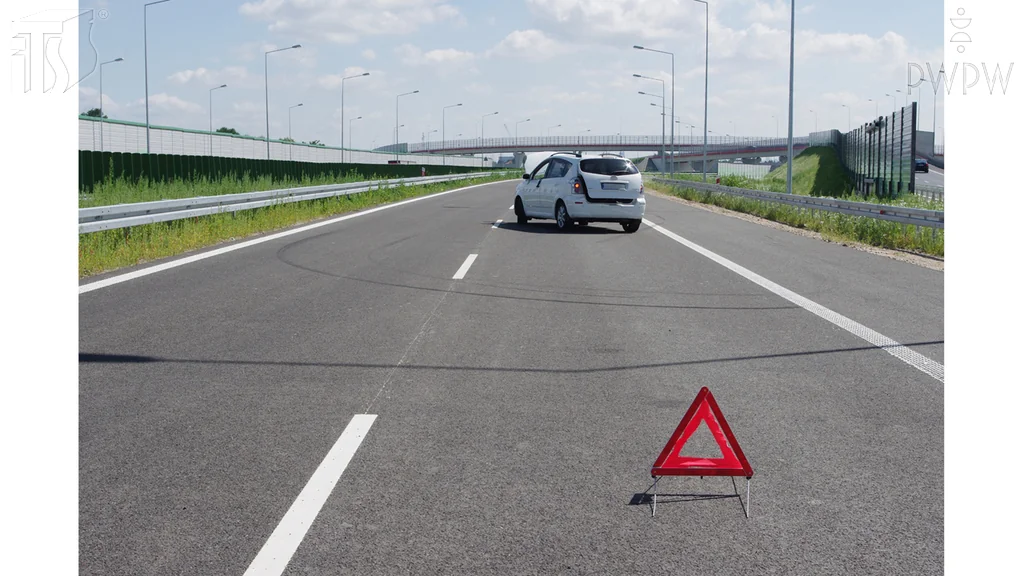
If you're involved in an accident on a motorway, are you obliged to signal the fact that your car is immobilized by placement of a warning triangle 100 m behind the car?
Show the correct answer
Correct answer
YES
Explanation
In the photo you can see a motorway roadway between noise barriers; a white car with its bonnet raised is standing in the right-hand lane, and far behind it a reflective warning triangle has been placed on the roadway. On a motorway, a vehicle that has come to a standstill must always be signalled, and the triangle must stand 100 m behind the car. The answer is: yes.
The Road Traffic Act requires you to signal that a vehicle is stationary because of a breakdown or accident on a motorway or expressway in every case - by switching on the hazard warning lights (or, if the vehicle does not have them, the sidelights) and placing a reflective warning triangle 100 m behind the vehicle, on the roadway or on the shoulder, depending on where the vehicle has come to a standstill. One hundred metres is about 130-140 steps for an adult; when you walk to put out the triangle, stay behind the crash barrier or at the outer edge of the shoulder and put on a high-visibility vest.
Legal basis: Art. 50 para. 1 point 1 and para. 2 point 1 of the Road Traffic Act (Prawo o ruchu drogowym)