
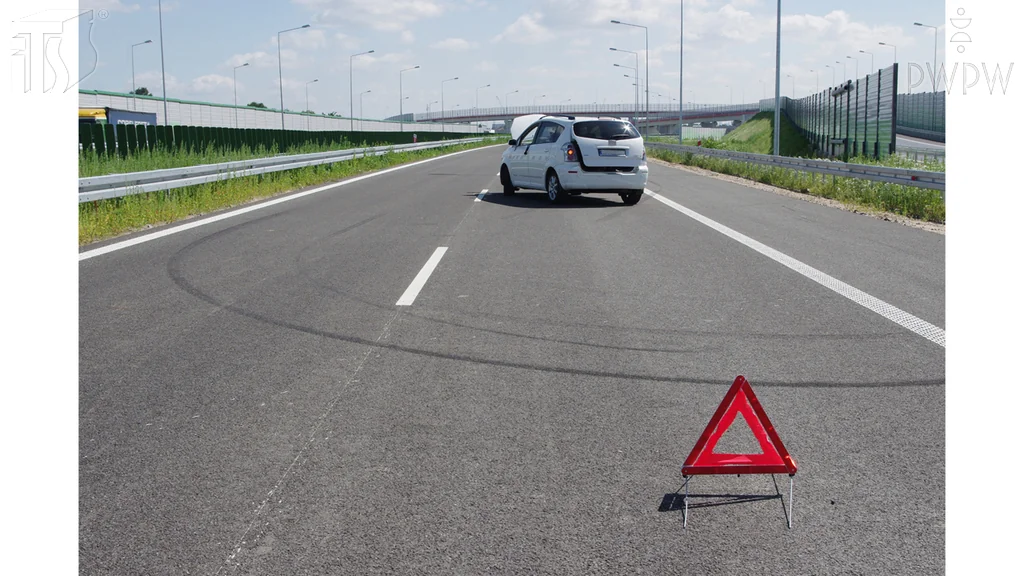
Is it correct to place a warning triangle at a distance of 30-50 m behind the car, if the car breaks down on an express road?
Show the correct answer
Correct answer
NO
Explanation
In the photo, you can see an expressway with noise barriers; a white car with its bonnet raised is standing in the right lane, and a dozen or so metres behind it, on the roadway, a reflective warning triangle has been placed. A distance of 30-50 m is the requirement for ordinary roads outside a built-up area; on an expressway, the triangle must be 100 m behind the vehicle. The answer is: no.
The Road Traffic Act requires you, on a motorway or an expressway, to signal a broken-down vehicle that is stationary by switching on the hazard warning lights and placing a reflective warning triangle 100 m behind the vehicle, on the roadway or on the shoulder, depending on where the car has come to a standstill. The distance of 30-50 m applies on other roads outside a built-up area. At speeds of 120-140 km/h, a driver needs a few seconds to react and change lanes, so the triangle must warn them much earlier.
Legal basis: Art. 50 para. 2 point 1 letter b and point 2 letter a of the Road Traffic Act (Prawo o ruchu drogowym)