
How does the braking distance of the vehicle change dependent on the speed increase?
Show the correct answer
Correct answer
A. The braking distance increases with an increase in speed.
Explanation
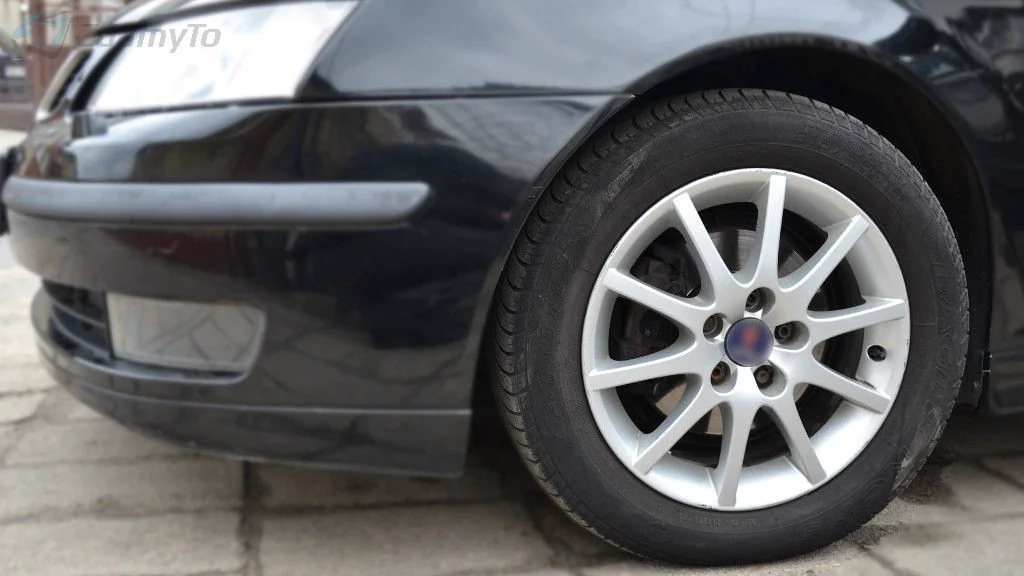
In the photo you can see the front wheel of a black car standing on a block-paved pavement - the tyre and the rim, behind which the brake is hidden. As speed increases, the braking distance gets longer - answer A. It does not get shorter (B) and does not stay the same (C).
The braking distance grows with the square of the speed: twice as fast means a braking distance four times longer, three times as fast - nine times longer. On dry asphalt a passenger car braking from 50 km/h needs about 13 m of braking alone, from 100 km/h already about 50 m, and on a wet surface much more. On top of that comes the distance travelled during the driver's reaction time, usually about one second - at 50 km/h this is nearly 14 m, at 100 km/h almost 28 m. That is why the Road Traffic Act requires you to drive at a speed that keeps the vehicle under control, adapted to the condition of the road, the weather and the traffic volume; in town and on a slippery road every 10 km/h less really shortens the distance you need to stop.
Legal basis: Art. 19 para. 1 of the Road Traffic Act (Prawo o ruchu drogowym)