
Should speed and distance from other road users be adapted to the road surface condition?
Show the correct answer
Correct answer
B. Yes, because the condition of the road surface has a significant impact on braking distances.
Explanation
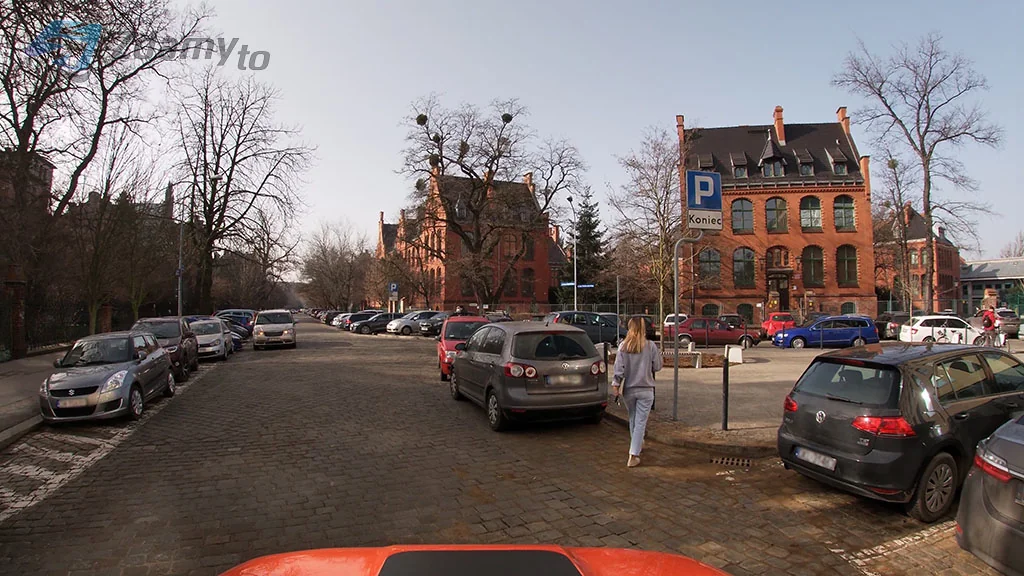
In the photo there is a car park with a paving-block surface, parked cars and a pedestrian. You must adapt your speed and your distance from other road users to the condition of the road surface, because the condition of the surface has a significant effect on the braking distance - answer B.
The Road Traffic Act requires a driver to drive at a speed that keeps the vehicle under control, taking into account the conditions in which traffic is moving, in particular the shape of the land, the condition of the road and its visibility, the condition and load of the vehicle, the weather conditions and the volume of traffic, and to keep the distance needed to avoid a collision if the vehicle in front brakes or stops. The braking distance depends on grip, and grip depends on the surface: on wet paving blocks, cobbles, mud or leaves it is much worse than on dry asphalt, so at the same speed you will stop much further on. Answers A and C limit this rule to a built-up area or to snowfall - but it applies always and everywhere, because the physics of braking knows no such exceptions. In a car park with paving blocks you also drive slowly because pedestrians and reversing cars appear suddenly.
Legal basis: Art. 19 para. 1 and para. 2 point 3 of the Road Traffic Act (Prawo o ruchu drogowym)