
Which of these factors has a direct influence on the braking distance?
Show the correct answer
Correct answer
A. driving speed.
Explanation
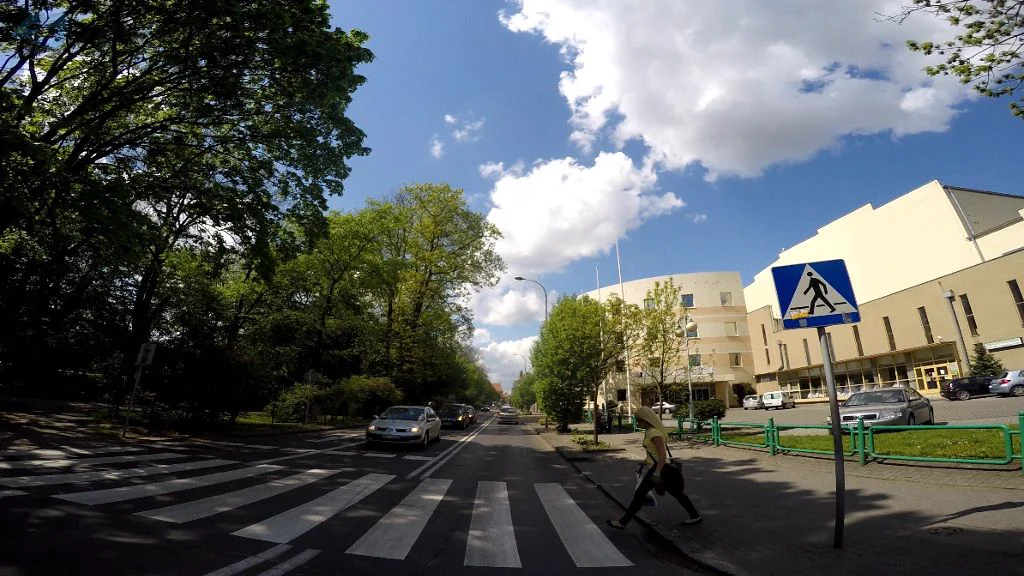
In the photo you can see a street in town with a pedestrian crossing, onto which a pedestrian is stepping. Driving speed has a direct influence on the braking distance - answer A. Road markings (B) and visibility on the road (C) affect when you notice a danger and start braking, but not how many metres the car travels from pressing the brake to stopping.
The Road Traffic Act requires the driver to drive at a speed that keeps the vehicle under control, taking into account the traffic conditions, in particular the shape of the terrain, the condition and visibility of the road, the condition and load of the vehicle, the weather conditions and the traffic volume. The braking distance grows with the square of the speed: twice as fast means a braking distance four times longer. On dry asphalt a car travelling at 50 km/h stops within about 12-15 m from the start of braking, at 70 km/h it already needs nearly 30 m, and at 100 km/h - about 60 m. On top of that comes the distance travelled during the reaction time - at 50 km/h another 14 m. That is why you slow down in good time before a pedestrian crossing - then, if necessary, you will stop before the crossing, not on it.
Legal basis: Art. 19 para. 1 of the Road Traffic Act (Prawo o ruchu drogowym)