
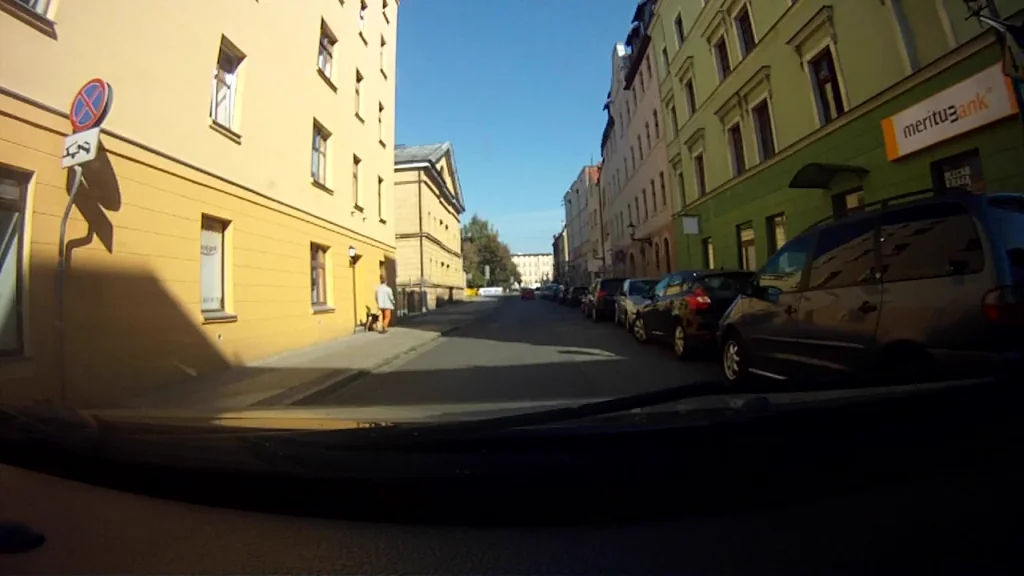
Does the visible prohibition sign only apply to the pavement?
Show the correct answer
Correct answer
NO
Explanation
In the photo, you are driving along a narrow street in a city between old tenement buildings; on the left, on the wall of a building, there is sign B-36 "no stopping" with plate T-24 showing a tow truck symbol, and on the right there are parked cars. The visible prohibition sign applies not only to the pavement - it covers the whole left side of the road. The answer is: no.
The Regulation on road signs and signals states that sign B-36 means a ban on stopping a vehicle and applies to the side of the road on which the sign is placed - the road, meaning the roadway, the shoulder and the pavement on that side; plate T-24 informs you that a vehicle left in a place covered by the ban will be removed from the road at the owner's expense. So the ban is not limited to the pavement or to the roadway: on the left side you must not stop anywhere, neither with your wheels on the kerb nor on the roadway next to it. In any case, under the Road Traffic Act, stopping a car on the pavement is possible only when there is no ban on stopping on that section of the roadway - and here there is one. The cars on the right are parked on the side that the sign does not cover. The only exception is a standstill forced by traffic, e.g. in a traffic jam.
Legal basis: § 28 para. 2, para. 3 point 1 and 3 and para. 5 of the Regulation on road signs and signals; Art. 47 para. 1 point 1 of the Road Traffic Act (Prawo o ruchu drogowym)