
What to bring to your driving test and when it will not take place
You go to the practical test with a valid identity document and, if your medical certificate has a restriction code, also with glasses or contact lenses. The regulation on driving tests states directly when the examiner will not run the test, when they will stop it and in which situations you do not pay for the next date. Below is the full list, the tables and a few tips for the day itself.
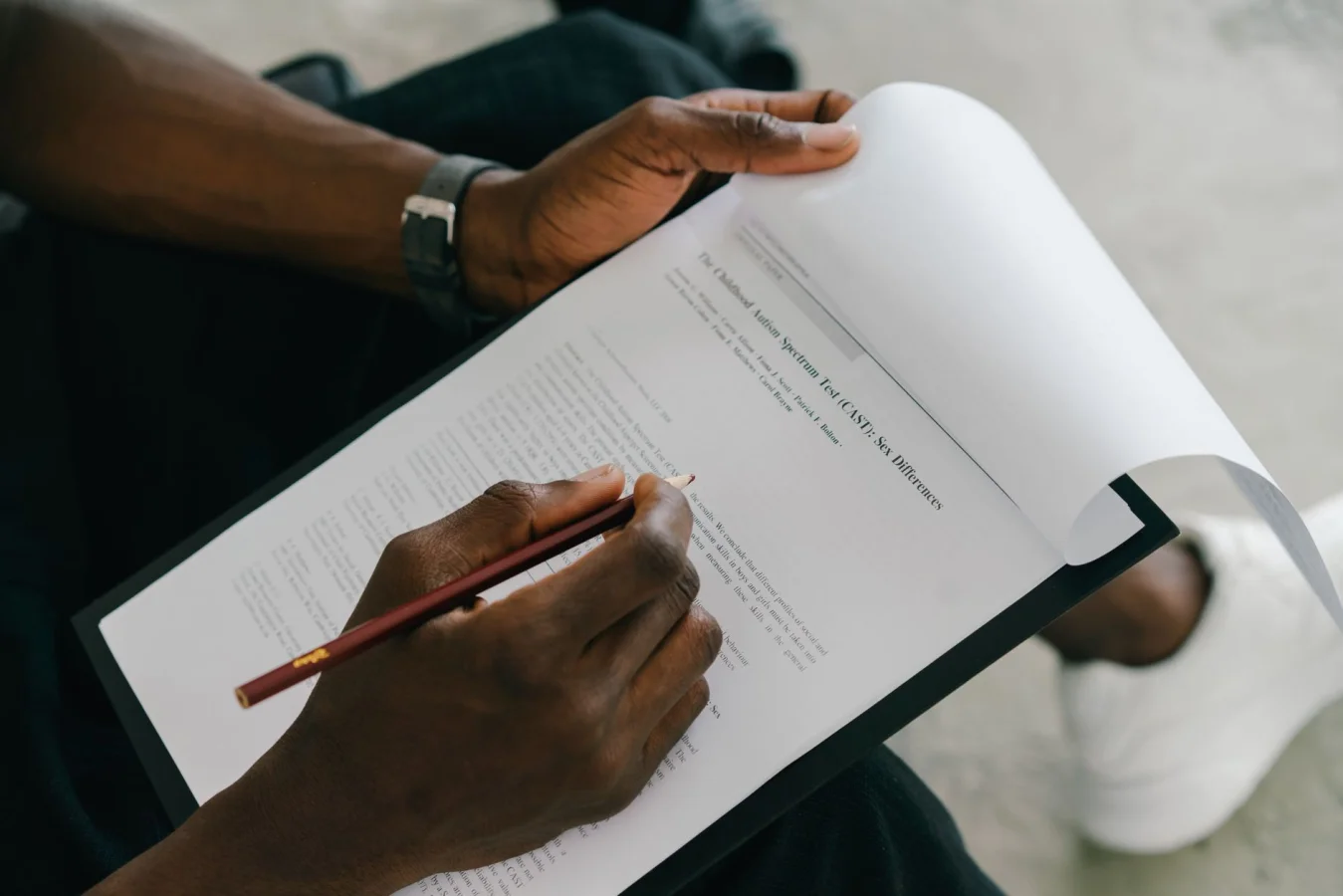
Photo: Mikhail Nilov / Pexels
This guide covers the Polish driving licence and the rules that apply in Poland. Legal status checked on 12 September 2026.
Bring a valid identity document (ID card, passport, residence card or mObywatel), glasses if your medical certificate requires them and, if under 18, parental consent. The test will not go ahead without proof of identity, after alcohol or without glasses; after a car breakdown or in bad weather the new date is free.
What documents to bring to the practical test
The most important item is a valid identity document. Without it the examiner cannot establish who you are, and the test will not take place. The regulation on driving tests (rozporządzenie w sprawie egzaminowania), § 12(1), lists what WORD (Wojewódzki Ośrodek Ruchu Drogowego, the regional driving test centre) accepts on the day of the test:
- a Polish ID card (dowód osobisty);
- another document confirming the identity and citizenship of a citizen of the EU, EFTA or Switzerland;
- a residence card (karta pobytu);
- a passport or another travel document;
- a temporary foreigner's identity certificate (tymczasowe zaświadczenie tożsamości cudzoziemca);
- a Polish identity document for a foreigner (polski dokument tożsamości cudzoziemca);
- a tolerated stay permit (zgoda na pobyt tolerowany);
- a document in the mObywatel app (the government app) shown to the examiner on your phone screen (a Ukrainian citizen may use the electronic document under the Act of 12 March 2022).
The document on your phone must be updated as of the day of the test. If the examiner has doubts, they may ask you to display the QR code.
§ 12 says nothing about a printout with your PKK number (Profil Kandydata na Kierowcę, the driver candidate profile) or about proof of payment: you give the PKK number when you book, and you pay the fee when you reserve a date. How test fees and booking work in 2026 is covered in a separate article.
Glasses, parental consent and other conditions the examiner will check
If your medical certificate contains a restriction code (for example glasses or contact lenses), you must meet that condition on the day of the test. A candidate without the glasses required by the certificate will not be admitted to the test (§ 15(1)). Restriction codes are entered in the certificate after the examination described in our article on the medical examination for a driving licence.
Anyone under 18 needs written consent from a parent or guardian to take the test (Act on Vehicle Drivers (ustawa o kierujących pojazdami), art. 50(2) point 8). From 3 March 2026 you can obtain category B from the age of 17, and you can take the test at the earliest one month before reaching the required age. Details of this route are in our text on getting a driving licence before 18.
A candidate who does not speak Polish may, at their own expense, arrange a sworn interpreter (§ 18 of the regulation). If the interpreter, or an instructor who was due to take part in the test, does not turn up, the test will not take place; the regulation does not waive the fee in this situation (§ 15(2) covers only causes beyond the candidate's control and a failure of the recording equipment). More about this option in our article on taking the driving test in a foreign language.
A motorcycle candidate brings their own protective clothing (boots, trousers, jacket, gloves), while WORD provides a vest, a helmet and protectors. Without the clothing the examiner will not run the test (§ 13(1) point 3 and § 15(1)).
Can you take the test in your driving school's car
The test takes place in a WORD vehicle. For categories AM, A1, A2, A, B and B+E it may, however, take place in a vehicle of the OSK (ośrodek szkolenia kierowców, the driving school) that trained you, if you submit an application and cover the cost (Act on Vehicle Drivers, art. 53(4a)). If that vehicle is not on site, the examiner will not run the test (§ 15(1)). The same applies to the vehicle for category B1.
Whichever car you drive, one item under the bonnet and one light are drawn at random on the manoeuvring area. What this looks like and how much time you have is described in our text on the vehicle checks in the driving test.
How to cancel a date without losing the fee
You can withdraw from a date in writing no later than 2 working days before the test (§ 11(6)-(8)). You can also withdraw electronically: through the WORD system or with a document signed with a trusted, qualified or personal signature. WORD then sets a new date without a new fee. WORD Warsaw confirms that a refund or transfer of the fee requires written notice no later than 2 days before the test.
In unforeseen cases described in the application, the WORD director may shorten this deadline. Anyone who does not turn up and does not cancel gets the next date only after paying a new fee (§ 11(5)).
| Situation | Effect on the fee |
|---|---|
| Written withdrawal at least 2 working days before the test | new date without a new fee |
| Later withdrawal, for an unforeseen reason described in the application | the WORD director decides |
| No-show without cancelling | next date only after a new fee |
In the Mazovia region (as of September 2026) the category B practical part costs 229.99 zł (PLN) and the theory part 56.98 zł, so cancelling in time has real value.
When the examiner will not run the test: table
The regulation (§ 15(1)) lists the situations in which the examiner does not run the test or does not continue it. The candidate does not pay another fee only where the cause is beyond their control (weather, a failure of the WORD system or of the test vehicle, § 15(1) point 4) and where the recording equipment fails (point 5), in line with § 15(2).
| Reason (§ 15(1)) | Does § 15(2) waive the new fee |
|---|---|
| The candidate's identity cannot be established | no |
| The candidate is under the influence of alcohol or a similar substance, or refused a test | no |
| The candidate offered the examiner a benefit | no |
| The conditions from the restriction codes in the medical certificate are not met (e.g. glasses) | no |
| A ground under art. 50(2)-(3) or art. 57 of the Act on Vehicle Drivers applies | no |
| The candidate did not provide the OSK vehicle, their own vehicle or the vehicle for B1 when that was the arrangement | no |
| No protective clothing (motorcycles) | no |
| The instructor or sworn interpreter who was due to take part did not turn up | no |
| Weather conditions, a failure of the WORD system, the test vehicle or the recording equipment, or other causes beyond the candidate's control | yes |
For the first group the regulation provides no fee waiver, so bear in mind that a forgotten ID card or glasses costs as much as a no-show.
Alcohol before the test: what happens if the examiner suspects it
If the examiner suspects that you are under the influence of alcohol or a similar substance, they call the authorised services to carry out a test (§ 14 point 2). Refusing the test works the same way as a positive result: the driving test will not take place (§ 15(1)), and one already under way will be stopped (§ 16(1)).
The evening before the test is a bad time for alcohol. The catalogue of exam questions has its own question on this: after a large amount of alcohol you do not drive the next morning (question 11510 on driving in the morning after drinking).
Manoeuvring area: when you will not go out on the road
The part in traffic is not carried out if, on the manoeuvring area, you drove a wheel over the line marking the outer edge of the bay, ran over or knocked down a cone or pole, or performed the same task on the area incorrectly twice (§ 12(2)). Where the table of tasks allows it, you are entitled to one correction of your path. Such a result on the area means a negative result for the practical part (§ 28); your passed theory test remains valid.
For category B there are three tasks on the area: preparing to drive with the technical check, moving off and driving a lane forwards and in reverse, and moving off on a hill. The full description of the tasks and criteria is in our article on the category B practical test tasks.
What stops the test in traffic
From 3 March 2026 the test may be ended before all tasks are completed when the candidate's behaviour may endanger the life or health of the examiner or another road user, or directly affects road safety (Act on Vehicle Drivers, art. 52(2)). The regulation (§ 16(1)) adds to this the behaviours from table 9 of annex 1, when they directly endangered life and health, stopping the test at the candidate's request, and refusing an alcohol test.
Selected behaviours from table 9:
| Behaviour | Example from the test |
|---|---|
| Causing a collision or accident, or behaviour that risks one | forcing your way through a junction |
| Passing a vehicle stopped before a pedestrian crossing | you overtake a car that is letting a pedestrian cross |
| Overtaking on a pedestrian crossing | a manoeuvre started right before the zebra |
| Failing to give way to a pedestrian on a crossing, when turning, reversing, joining traffic and in a residential zone | turning right without letting a pedestrian cross |
| Failing to comply with traffic lights, the instructions of a person directing traffic, a stop sign, no entry, no turning, mandatory signs, a double solid line, no vehicles | driving through a red light |
| Failing to give way at a junction, to rail vehicles, to cyclists, when changing lane | cutting in front of a tram |
| Breaching a no U-turn rule | making a U-turn under a prohibition sign |
| Exceeding the speed limit by more than 20 km/h | 71 km/h in a built-up area |
| Failing to make sure overtaking is possible | overtaking without checking the mirror |
Smaller mistakes do not stop the test, but they count towards the result: the same task performed incorrectly twice gives a negative result (§ 28). The examiner tells you about a mistake straight away, naming the task. Driving in traffic lasts at least 40 minutes, and with a positive result and all tasks completed the examiner may end it after 25 minutes. What to do after a negative result is described in our article on a failed driving test.
When the test ends through no fault of yours and without a new fee
The test may also be ended early for reasons beyond your control: a failure of the recording equipment, a vehicle breakdown with no replacement vehicle, or because it was conducted in breach of the rules (§ 16(2)). In such cases you get the next date without a new fee (§ 16(5)).
The category B practical part is recorded (video and audio), and the recording is kept for 21 days (Act on Vehicle Drivers, art. 54). If you believe the test was conducted in breach of the rules, you have 14 days from the day of the test to file a complaint with reasons to the marshal of the voivodeship (the head of the regional government), submitted through the WORD director (art. 68(1)).
Tips for the test day: what helps, even if it is not a rule
The tips below do not come from the regulation.
- The day before, put your identity document and glasses in one place, update mObywatel and check that it opens.
- Charge your phone fully if your document is in the app.
- Plan your journey with time to spare, so you do not start the test out of breath.
- Do not drink alcohol the day before, not even a little.
- Get a good night's sleep and eat something before you leave.
If stress is paralysing you, simple diaphragmatic breathing helps: breathe in through your nose counting to 5 and out counting to 5, for a few minutes before you go onto the area. We have collected more techniques in our article on driving test nerves. On the area, start by adjusting the seat, mirrors and head restraint, fasten your seat belt and check the doors: this is the first task of the test and the easiest points to score.
Frequently asked questions
Is mObywatel enough for the practical test instead of an ID card?
Yes, § 12(1) of the regulation allows a document in the mObywatel app shown on your phone screen, provided it is updated as of the day of the test. The examiner may ask you to display the QR code.
What happens if I forget my glasses for the test?
If your medical certificate contains a restriction code requiring glasses or contact lenses, the examiner will not run the test. The regulation does not waive the fee for the next date in this situation.
By when can I cancel the practical test so as not to lose the fee?
In writing, no later than 2 working days before the test, also electronically through the WORD system. WORD then sets a new date without an additional fee. In an unforeseen event the WORD director may accept a later withdrawal.
Do I pay a second time for a test cancelled because of the weather or a vehicle breakdown?
No. Weather conditions, a failure of the WORD system, the test vehicle or the recording equipment, and other causes beyond the candidate's control are situations in which you do not pay another fee.
Does a minor need parental consent at the test?
Yes. A person under 18 takes the test with the written consent of a parent or guardian. If the conditions of art. 50 of the Act are not met, the examiner will not run the test.
Does knocking down a cone on the manoeuvring area end the test?
Yes. Running over or knocking down a cone or pole, like driving a wheel over the edge line of the bay, means that the part in traffic does not take place and the result is negative.
Can I stop the practical test myself?
Yes, the regulation provides for stopping the test at the candidate's request. This is not one of the situations in which § 16(5) waives the next fee, so you will book a new date after paying it.
Sources
- Rozporządzenie Ministra Infrastruktury z dnia 24 listopada 2023 r. w sprawie egzaminowania osób ubiegających się o uprawnienia do kierowania pojazdami (Dz.U. 2023 poz. 2659) , Dziennik Ustaw (2023-12)
- Ustawa z dnia 5 stycznia 2011 r. o kierujących pojazdami (tekst jednolity Dz.U. 2025 poz. 1226) , Dziennik Ustaw (2025-09)
- Ustawa z dnia 17 października 2025 r. o zmianie ustawy Prawo o ruchu drogowym oraz niektórych innych ustaw (Dz.U. 2025 poz. 1676) , Dziennik Ustaw (2025-12)
- Opłaty egzaminacyjne , WORD Warszawa (2026-01)