
Which commercial road transport vehicle should be fitted with a tachograph?
Show the correct answer
Correct answer
C. Vehicle of gross weight rating 2800 kg, pulling a trailer of gross weight 750kg.
Explanation
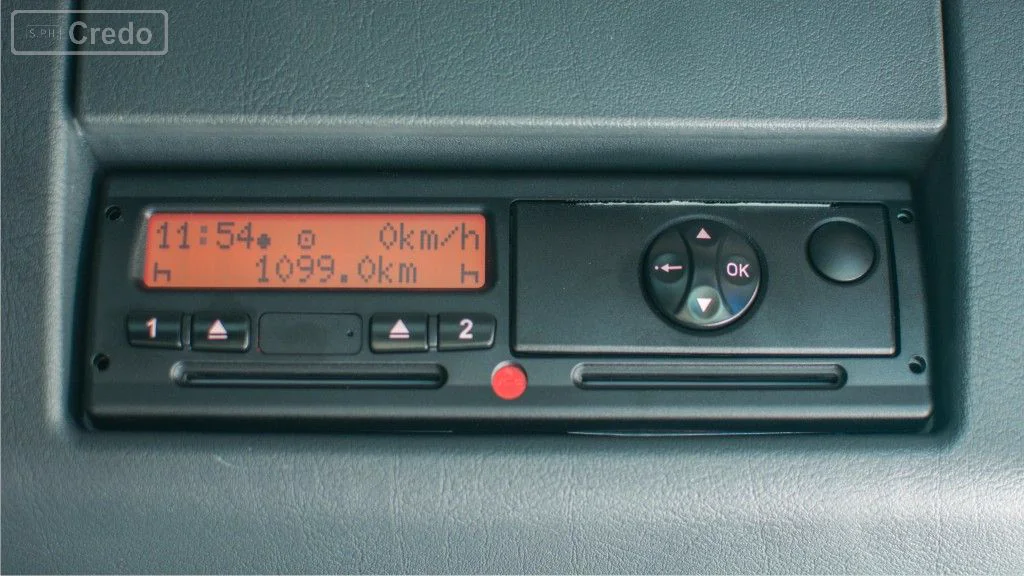
In the photo you can see a digital tachograph in the cab, with a display of speed and distance and two driver card readers. A tachograph should be fitted in a vehicle with a maximum permissible mass of 2800 kg pulling a trailer with a maximum permissible mass of 750 kg - answer C.
The EU Regulation applies to the carriage of goods when the maximum permissible mass of the vehicles, including a trailer or semi-trailer, exceeds 3.5 tonnes - and it is this total that decides whether a tachograph is required. The combination from answer C weighs 3550 kg in total, so it exceeds the threshold and must have a tachograph. A vehicle with a maximum permissible mass of 3450 kg on its own (answer A) and a 2800 kg vehicle without a trailer (answer B) are below 3.5 tonnes, so in domestic transport the obligation does not cover them; in international carriage of goods and in cabotage the threshold has been lower since 1 July 2026 and is 2.5 tonnes. This is a typical trap: the trailer counts towards the mass of the combination, and exceeding the threshold means not only a tachograph, but also the rules on driving time, breaks and rest periods.
Legal basis: Art. 2 para. 1 letter a and aa of Regulation (EC) No 561/2006; Art. 3 para. 1 of Regulation (EU) No 165/2014