
When should you cease any resuscitation activities towards a person who is a victim of an accident?
Show the correct answer
Correct answer
B. After the restoration of life functions (pulse, breathing).
Explanation
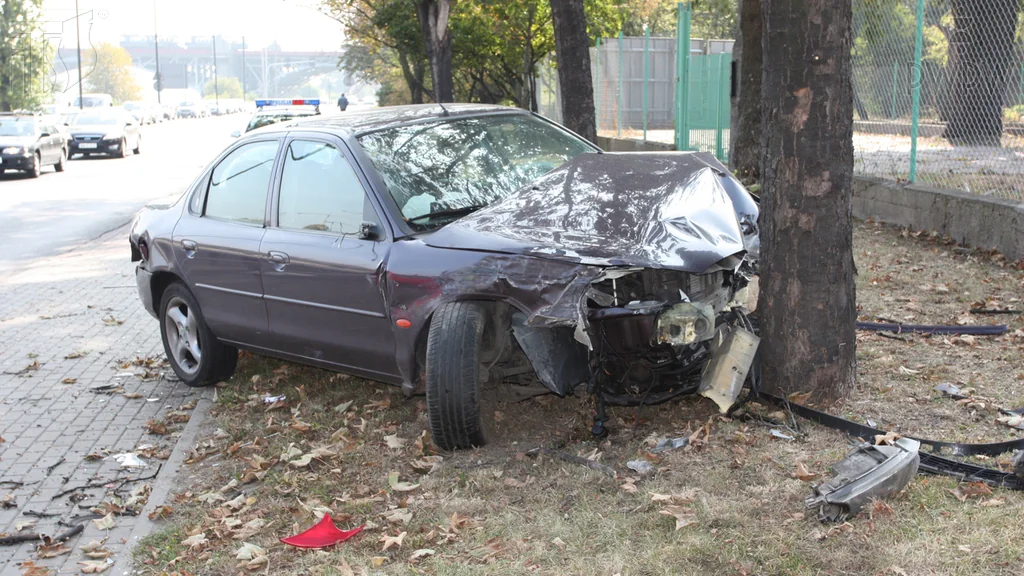
In the photo, a wrecked car has crashed into a tree, and a police car can be seen in the background - the scene of a serious accident. You stop cardiopulmonary resuscitation after vital functions, that is circulation and breathing, have been restored - answer B.
The Road Traffic Act requires a person involved in an accident to give the necessary help to the victims and to call the emergency medical team, and resuscitation, once started, is continued without a break until the casualty starts to breathe, move or cough, until paramedics take over, or until the rescuer is exhausted. A broken rib (answer A) often happens during compressions and is not a reason to stop - you continue the compressions, only checking the position of your hands. Calling the ambulance (answer C) is not the end but the beginning: you call before starting compressions or during them on speakerphone, and the operator tells you what to do. The pattern is: 30 compressions in the middle of the chest to a depth of 5-6 cm at a rate of 100-120 per minute, then 2 rescue breaths; if you cannot or do not want to give rescue breaths, you do compressions without a break. If there is an AED nearby, you tell someone to bring it.
Legal basis: Art. 44 para. 2 point 1 of the Road Traffic Act (Prawo o ruchu drogowym); Art. 162 § 1 of the Criminal Code