
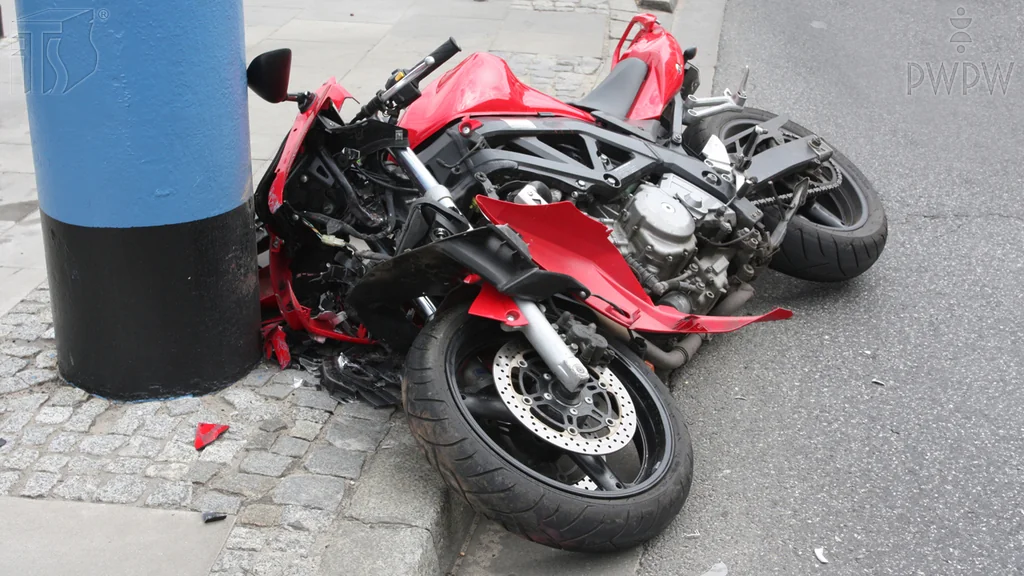
What should you do if a fall from a single-track vehicle results in a head injury with visible nose-bleeding or ear-bleeding?
Show the correct answer
Correct answer
A. Immobilize the head and the neck section of the spine, and apply a protective dressing.
Explanation
In the photo, a wrecked motorcycle is lying next to a post - an accident on a two-wheeler, after which the rider most often has head injuries. When a casualty has a head injury with bloody discharge from the nose or ear, you immobilise the head and the cervical spine and apply a protective dressing - answer A.
The Road Traffic Act obliges a person involved in an accident to give the necessary help and to call the emergency medical team. Blood or clear fluid coming out of the ear or nose after a blow to the head is a sign of a fracture of the base of the skull - and in such a case you always also suspect a cervical spine injury. That is why you do not move the casualty's head; you stabilise it with your hands on both sides in the position in which you find it, and you only loosely cover the place of the discharge with sterile gauze. A pressure dressing (answer B) is a mistake here: stopping the discharge from the ear can raise the pressure inside the skull and makes infection more likely. "Do not touch" (answer C) is also wrong - the casualty may stop breathing, and for an unconscious person you must keep the airway open. You do not remove the helmet unless the casualty is not breathing and you have to start CPR. You call the ambulance and wait, watching the breathing.
Legal basis: Art. 44 para. 2 point 1 of the Road Traffic Act (Prawo o ruchu drogowym); Art. 162 § 1 of the Criminal Code