
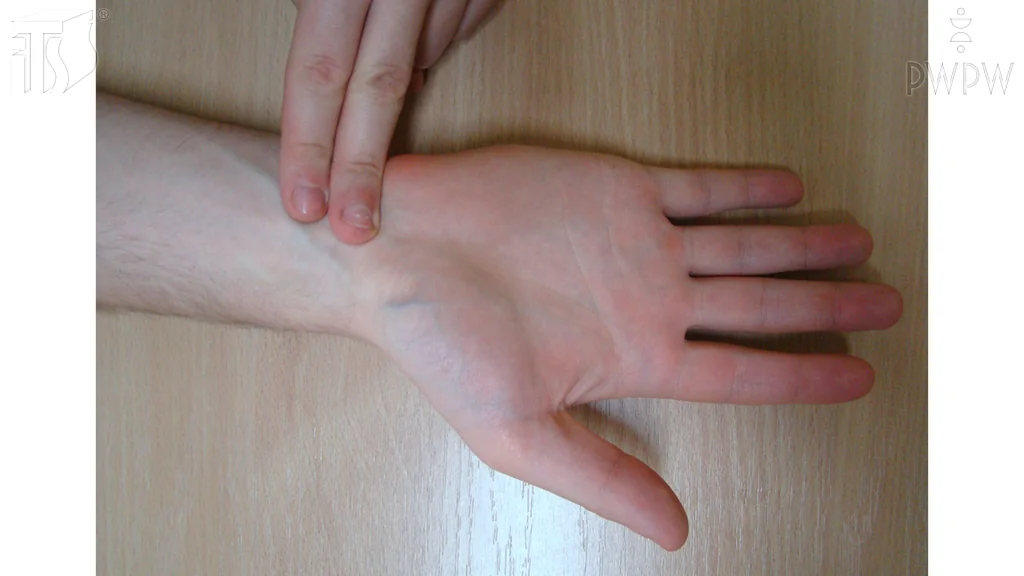
How should you administer first aid to a victim of an accident who still has a pulse, but is not breathing?
Show the correct answer
Correct answer
C. I should clear the respiratory tract, and if this is ineffective, I should commence resuscitation.
Explanation
In the photo, two fingers are checking the pulse on a wrist. When a casualty has a detectable pulse but is not breathing, you open the airway, and if this does not work, you start resuscitation - answer C.
The Road Traffic Act requires a person involved in an accident to give the necessary help to the victims and to call the emergency medical team. The most common cause of an unconscious person not breathing is the tongue, which falls back and blocks the throat - that is why the first action is opening the airway: tilting the head back and lifting the jaw - also in an accident victim, because an open airway is more important than protecting the neck. Often this is enough and the casualty starts breathing. If within 10 seconds you do not find normal breathing, you start resuscitation: 30 compressions and 2 breaths. A pulse can be misleading for a layperson - it is hard to feel under stress, and without breathing the heart will stop within minutes anyway, so you treat the absence of breathing as cardiac arrest. "Do not touch" (answer A) condemns the victim to death, and heart massage without opening the airway (answer B) skips the simplest and most effective action.
Legal basis: Art. 44 para. 2 point 1 of the Road Traffic Act (Prawo o ruchu drogowym); Art. 162 § 1 of the Criminal Code