
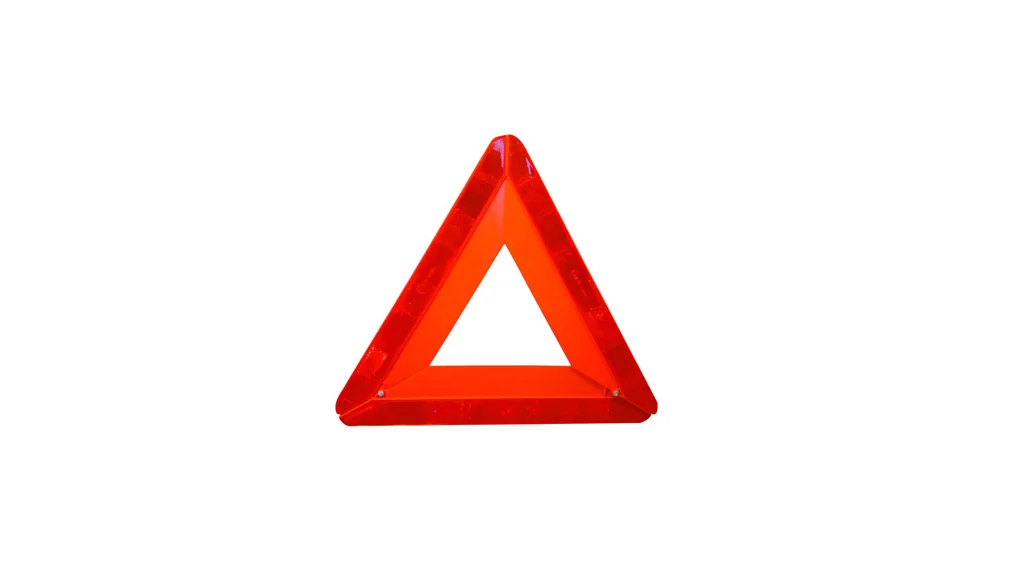
Is the vehicle driver obliged to signal the stop of a motor vehicle or trailer due to damage or an accident on the expressway?
Show the correct answer
Correct answer
YES
Explanation
The illustration shows a red reflective triangle, which every car must have in its equipment. The driver is obliged to signal that a power-driven vehicle or trailer is stationary due to a breakdown or accident on an expressway. The answer is: yes.
The Road Traffic Act treats an expressway in the same way as a motorway: if a power-driven vehicle or trailer is stationary on it due to a breakdown or accident, you must signal this in every case, also on the emergency lane (hard shoulder). The method is the same - you switch on the hazard warning lights, and if the vehicle does not have them, the sidelights, and you place the warning triangle 100 m behind the vehicle, on the roadway or the shoulder, depending on where the car stopped; the signalling lasts for the whole time the vehicle is stationary. On other roads the obligation is narrower: outside a built-up area, you place the triangle 30-50 m behind the vehicle only if it is on the roadway in a place where stopping is prohibited, or it is on the shoulder and cannot be seen from a sufficient distance. On an expressway traffic is fast and nobody expects a stationary car, so the requirements are stricter. The Regulation on the technical conditions of vehicles requires every car to carry a triangle, so check that yours is in the boot.
Legal basis: Art. 50 para. 1 point 1, para. 2 point 1 and 2 and para. 3 of the Road Traffic Act (Prawo o ruchu drogowym)