
While driving a bus, when do you have to switch from high-beam to low-beam lights?
Show the correct answer
Correct answer
A. When another vehicle is approaching from the opposite direction.
Explanation
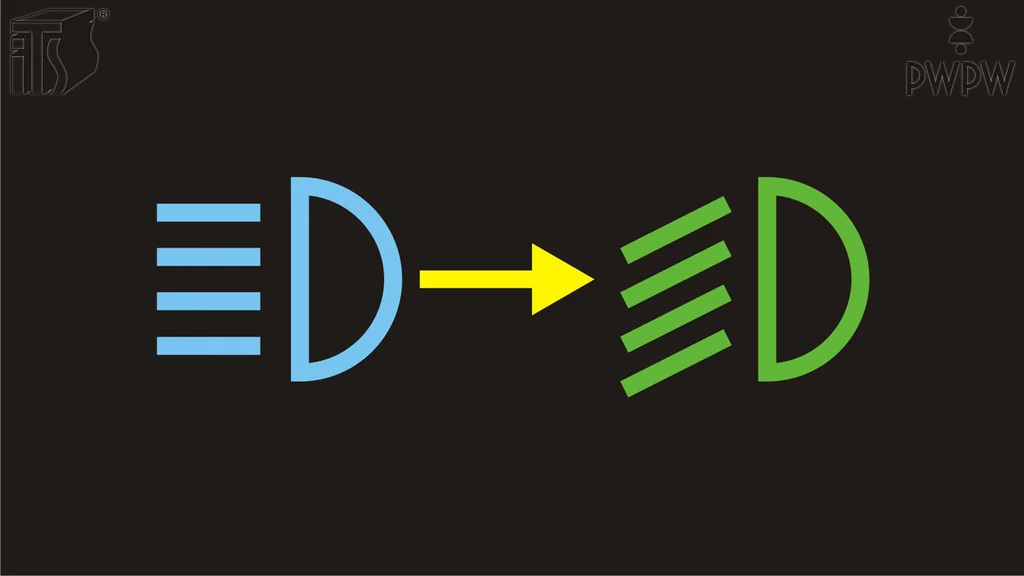
In the drawing you can see the main beam symbol (blue) with an arrow leading to the dipped headlights symbol (green). You must switch from main beam to dipped headlights when another vehicle is approaching from the opposite direction - answer A.
The Road Traffic Act requires a driver using main beam headlights to switch to dipped headlights when a vehicle is approaching from the opposite direction, and if one of the drivers has switched off the main beam, the other must do the same. You must do the same when approaching a vehicle in front, if its driver could be dazzled. Rain alone (answer B) does not require you to switch the lights, although in a downpour main beam reflects off the drops and can get in the way. Entering a built-up area (answer C) is not a reason in itself either - what matters is whether the road is lit and whether you are dazzling anyone. The headlamps of a bus are high, so you switch them early.
Legal basis: Art. 51 para. 3 point 1 and 2 of the Road Traffic Act (Prawo o ruchu drogowym)