
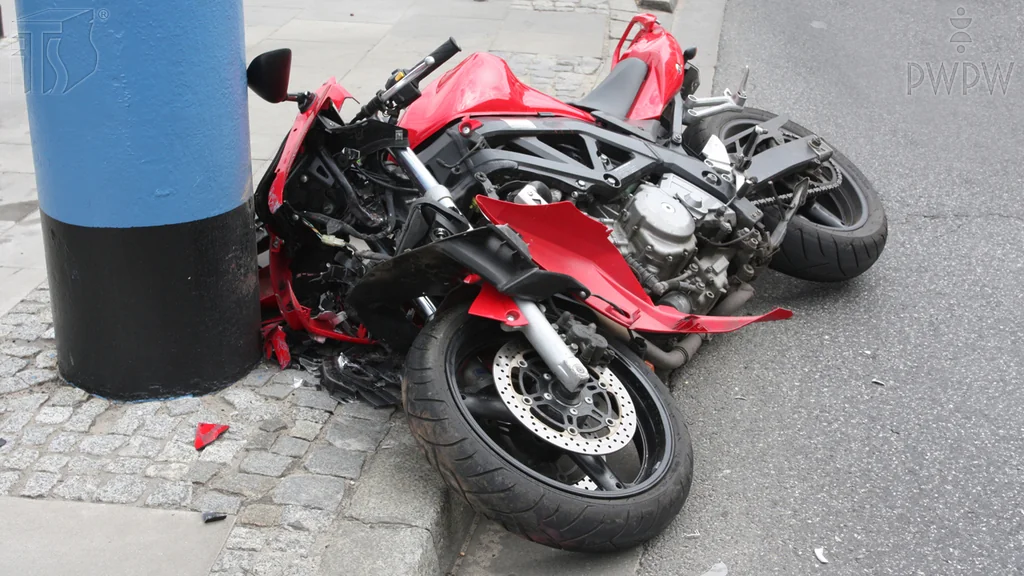
What injuries usually accompany severe head injuries suffered after a fall from a single-track vehicle?
Show the correct answer
Correct answer
C. Injuries to the neck section of the spine and the skull.
Explanation
In the photo, a wrecked sports motorcycle is lying next to a lamp post - a typical result of hitting an obstacle at high speed. Serious head injuries after a fall from a two-wheeler are usually accompanied by an injury to the cervical spine and the skull - answer C.
The Road Traffic Act requires a person involved in an accident to give the necessary help to the victims, and to help well, you need to know what to expect. When a rider falls off a motorcycle, the head in a helmet hits an obstacle or the road surface with all the energy of the moving body; the helmet softens the blow, but the neck - the most mobile and weakest section of the spine - bends or twists sharply under the weight of the head and the helmet. That is why a serious head injury and a cervical spine injury almost always go together, and skull fractures come on top of that. The lumbar and thoracic sections (answers A and B) are protected by muscles and ribs and are injured less often with a head injury. The practical conclusion: you treat a motorcyclist after a fall as a person with a damaged cervical spine - you do not remove the helmet, you do not lift them, you stabilise the head with your hands and wait for the paramedics with a collar and a spinal board. The exception is when the casualty is not breathing - then you save their life.
Legal basis: Art. 44 para. 2 point 1 of the Road Traffic Act (Prawo o ruchu drogowym); Art. 162 § 1 of the Criminal Code