
How is braking on a wet road affected by using tyres having tread wear exceeding maximum safety limits?
Show the correct answer
Correct answer
C. Decrease of friction and the lengthening of the braking distance.
Explanation
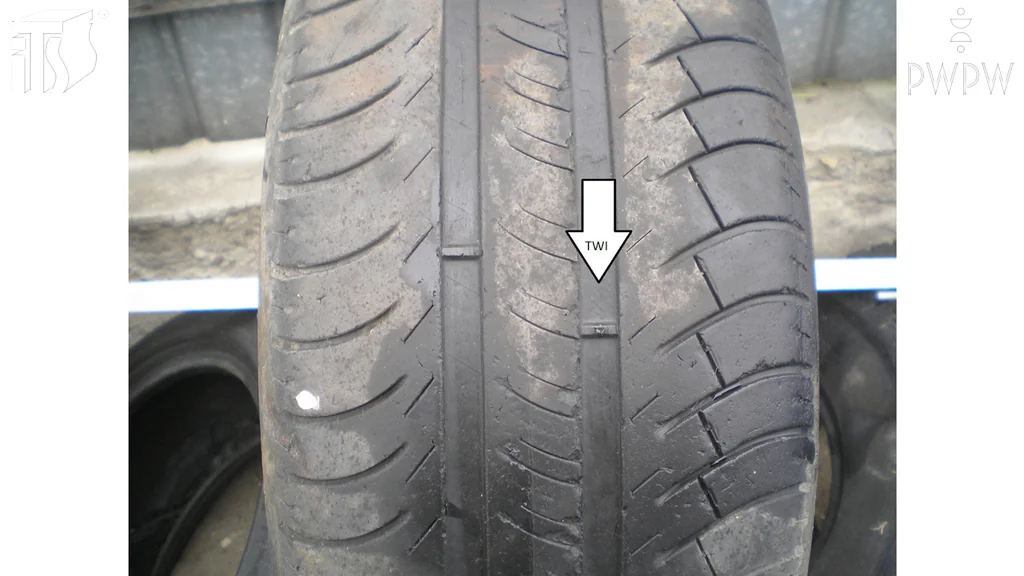
In the photo you can see the tyre tread with an arrow and the letters TWI, pointing to the tread wear indicator. Driving on tyres with excessively worn tread when braking on a wet surface causes reduced friction and a longer braking distance - answer C. Increased friction (A) and a shorter braking distance (B) are the opposite of the real effects.
The grooves of the tread carry water away from under the tyre; when they are shallow, the tyre cannot push the water out fast enough, it rides up on a layer of water (aquaplaning) and loses contact with the asphalt. The Regulation on the technical conditions of vehicles prohibits fitting a vehicle with tyres whose indicators show the limit of tread wear, and, for tyres without indicators, with a tread depth of less than 1.6 mm. The TWI indicator is a small bump in the groove: when the tread is level with it, the tyre must be replaced. Manufacturers recommend replacing it as soon as the tread is down to 3 mm, because on a wet road the braking distance with 3 mm is clearly shorter than with 1.6 mm.
Legal basis: § 11 para. 7 point 4 of the Regulation on the technical conditions of vehicles and the scope of their necessary equipment; Art. 66 para. 1 point 1 of the Road Traffic Act (Prawo o ruchu drogowym)