
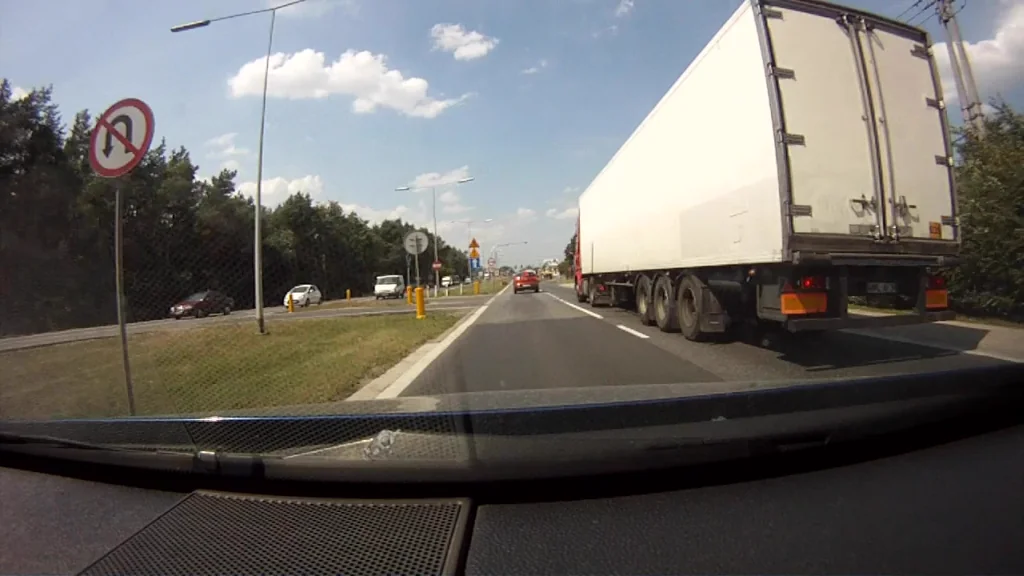
Does the visible prohibition sign apply only to the nearest intersection inclusive?
Show the correct answer
Correct answer
YES
Explanation
In the photo you are driving on a dual carriageway outside a city, going past a lorry with a semi-trailer; on the left there is sign B-23 "no U-turn". The visible prohibition sign applies only up to and including the nearest junction. The answer is: yes.
The Regulation on road signs and signals states that sign B-23 "no U-turn" prohibits drivers from making a U-turn up to and including the nearest junction, and sign B-24 "end of no U-turn" means that the ban is cancelled before the junction. The word "including" (włącznie) is important: you must not make a U-turn either on the section between the sign and the junction, or at the junction itself, for example by using the entrance of an intersecting road. After the junction the ban ends by itself, unless it is repeated by another sign; it can also end earlier if the road authority puts up B-24. For comparison, the general rule says that most bans, for example from B-25 or B-33, apply up to the nearest junction, and B-23 differs in that it also covers the junction itself. Beyond sign B-23 you must not make a U-turn through a gap in the central reservation either.
Legal basis: § 22 para. 5 and 6 and § 32 para. 2 of the Regulation on road signs and signals