
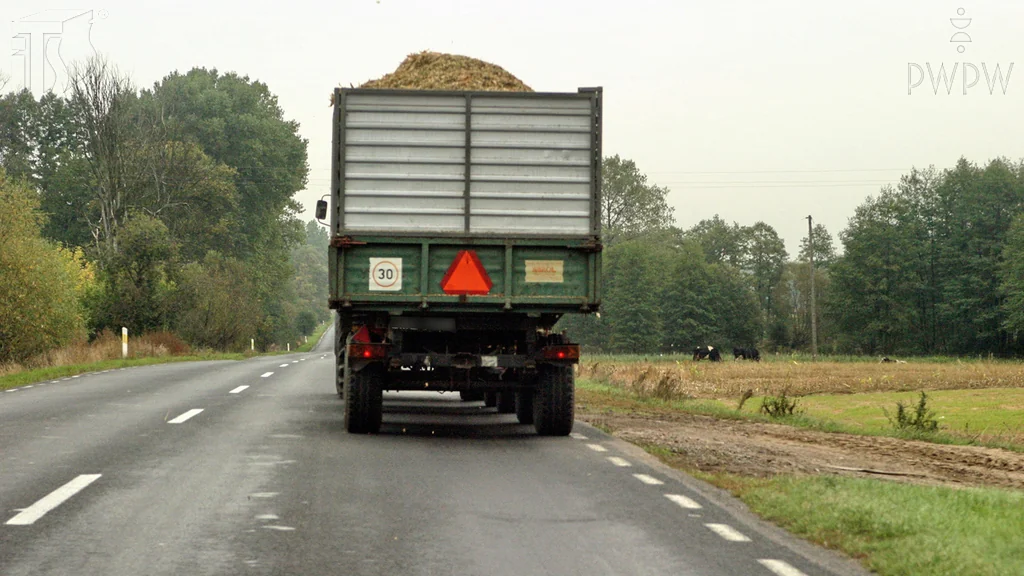
How should you transport loose cargo?
Show the correct answer
Correct answer
A. In a tight container, with appropriate covers.
Explanation
In the photo, an agricultural trailer with high sides is driving ahead of us. It is marked with a triangular slow-moving vehicle plate (tablica wyróżniająca) and a "30" plate, and it carries a loose load heaped up above the top edge of the sides. Loose cargo is carried in a tight (sealed) load box with suitable covers - answer A.
The Road Traffic Act states directly that loose cargo may only be placed in a tight load box, additionally secured with covers that stop the load from spilling onto the road. Grain, sand, gravel or chaff falling through gaps or blown off the top forms a slippery layer on the roadway, and a small stone thrown up by a wheel can break the windscreen of a vehicle behind. Any load box (answer B) may have leaking sides and tailgates. A tarpaulin on any load box (answer C) protects from above, but it will not seal the floor and the walls. A heap above the sides, as in the photo, is easily blown away by the wind, so you cover it with a net or a tarpaulin. Soiling the road is forbidden, and a spilled load is cleaned up at once.
Legal basis: Art. 61 para. 5 and Art. 45 para. 1 point 9 of the Road Traffic Act (Prawo o ruchu drogowym)