
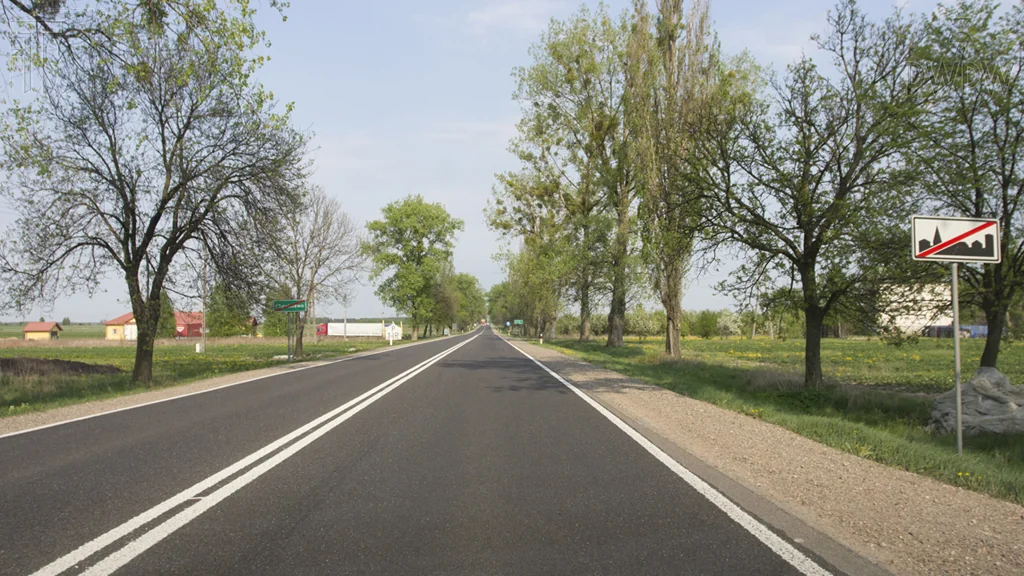
At what speed are you allowed to drive a passenger car on the road beyond this sign?
Show the correct answer
Correct answer
C. 90 km/h.
Explanation
In the photo you are driving on a two-way single-carriageway road, and on the right there is sign D-43 "end of built-up area". Beyond this sign you are allowed to drive a passenger car at a maximum of 90 km/h - answer C. The 100 km/h limit (B) applies to dual carriageways with two lanes in each direction, and 70 km/h (A) applies to vehicle combinations on ordinary roads.
The Road Traffic Act states that the speed limit for a passenger car outside built-up areas on roads other than a motorway, an expressway and a dual carriageway with at least two lanes in each direction is 90 km/h. The Regulation on road signs and signals specifies that D-43 marks the exit from a built-up area, and therefore the end of the 50 km/h limit. On such a road overtaking takes place in the lane for the opposite direction, so 90 km/h is the maximum, not the target.
Legal basis: Art. 20 para. 3 point 1 letter d of the Road Traffic Act (Prawo o ruchu drogowym); § 58 para. 3 of the Regulation on road signs and signals