
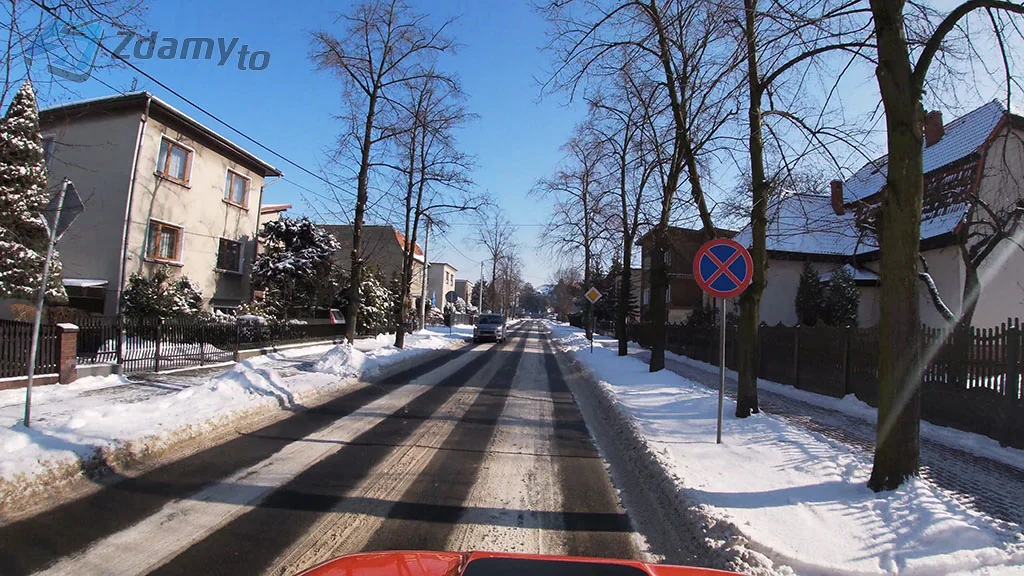
Are you obliged to switch on your hazard lights beyond this sign to indicate that the damaged vehicle is stationary?
Show the correct answer
Correct answer
YES
Explanation
In the photo, in winter, you are driving along a street in a town; on the right there is a round sign with a blue background, a red border and two crossed red lines - B-36 "no stopping". If your broken-down vehicle stops on the roadway beyond this sign, you have to switch on the hazard warning lights. The answer is: yes.
The Road Traffic Act states that a driver must signal that a power-driven vehicle is parked because of a breakdown or an accident on hard-surfaced roads other than a motorway and an expressway: in a built-up area, when it is parked on the roadway in a place where stopping is prohibited. Sign B-36 means exactly a ban on stopping, and a street in a town, beyond sign D-42, is a built-up area, so both conditions are met. The way to signal this in a built-up area is to switch on the hazard warning lights; only when the vehicle has no hazard warning lights do you switch on the sidelights (position lights) and place a warning triangle behind the vehicle or on it, no higher than 1 m. Signalling is required for the whole time the vehicle is parked. Outside a built-up area, in addition to the hazard warning lights, there is a triangle 30-50 m behind the vehicle, and on a motorway 100 m.
Legal basis: Art. 50 para. 1 point 2 letter b, para. 2 point 2 letter b and para. 3 of the Road Traffic Act (Prawo o ruchu drogowym); § 28 para. 2 of the Regulation on road signs and signals