
If a vehicle becomes immobilised at a level crossing, should you remove it from the crossing immediately?
Show the correct answer
Correct answer
YES
Explanation
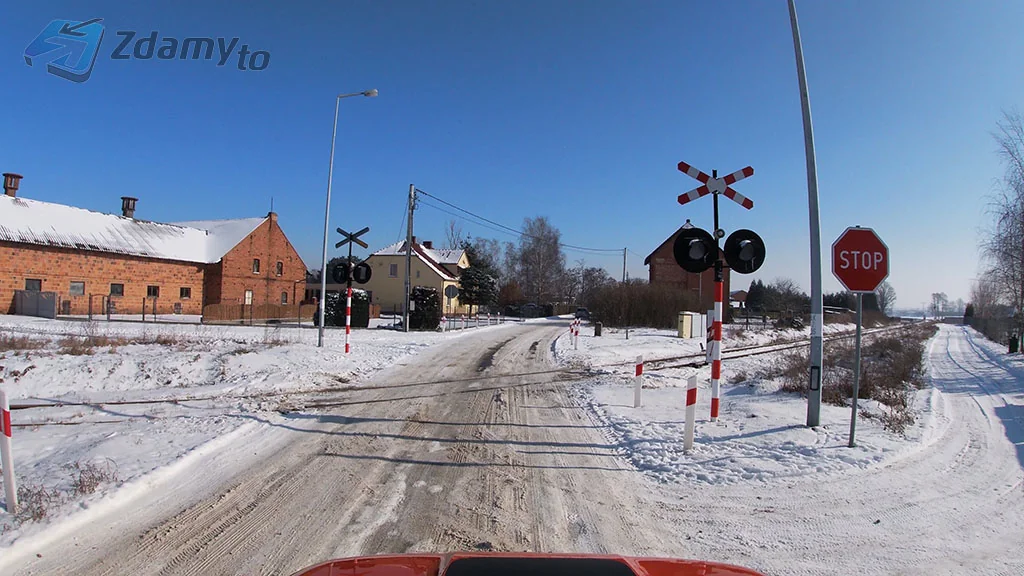
In the photo, in winter, you are approaching a level crossing without barriers; before the tracks there are sign B-20 "STOP", a St Andrew's cross and traffic lights with two red lights. If the vehicle comes to a standstill on a level crossing, you must remove it from the crossing immediately. The answer is: yes.
The Road Traffic Act states that if a vehicle comes to a standstill on a level crossing, the driver must remove it from the crossing immediately, and if this is not possible, warn the driver of the rail vehicle of the danger. A train needs hundreds of metres to brake and cannot go around an obstacle, so every second counts: if the engine has stalled, you try to start it, and if that does not work, you push the car off the tracks - with the passengers, with the help of other drivers, in first gear using the starter motor if necessary. If the vehicle cannot be moved, you lead the people away from the track, and you yourself run along the tracks in the direction from which a train may come and give signals to the train driver, for example by waving something bright; you also call 112. To prevent this, before entering you make sure that there is space beyond the crossing to continue driving, and you do not change gears on the tracks.
Legal basis: Art. 28 para. 4 and para. 3 point 2 of the Road Traffic Act (Prawo o ruchu drogowym)