
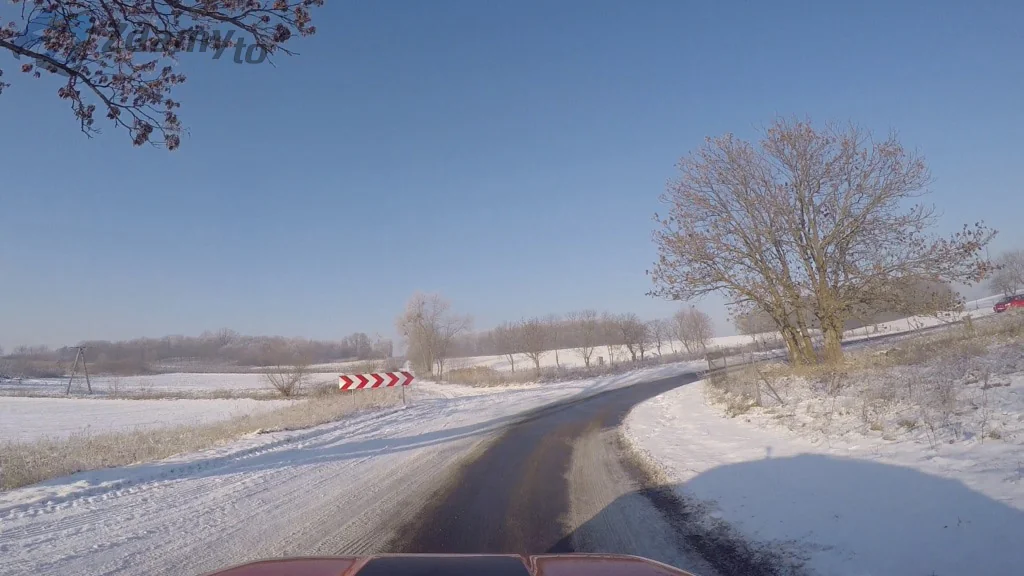
What behaviour increases the risk of skidding on icy road surfaces?
Show the correct answer
Correct answer
C. Violent turning of the steering wheel.
Explanation
On ice, the risk of skidding is increased by turning the steering wheel sharply - the answer is C. In a sudden turn the tyres must transfer a large sideways force, and on ice there is not enough grip to provide it: the front wheels slide straight on (understeer) or the rear of the car swings out and tries to get ahead of the front (oversteer). In the photo the road bends to the right (shown by the red and white guide boards U-3), so you must change your path early and smoothly.
Driving at a constant speed (A) and engine braking (B) are exactly the techniques recommended on a slippery surface, because they do not cause sudden changes in the forces acting on the wheels. The Road Traffic Act requires you to drive at a speed that allows you to keep control of the vehicle, taking into account the conditions in which you are driving - on ice this means slowing down before a bend and turning gently.
Legal basis: Art. 19 para. 1 of the Road Traffic Act (Prawo o ruchu drogowym)