
What behaviour increases the risk of skidding on icy road surfaces?
Show the correct answer
Correct answer
A. Sudden hard braking.
Explanation
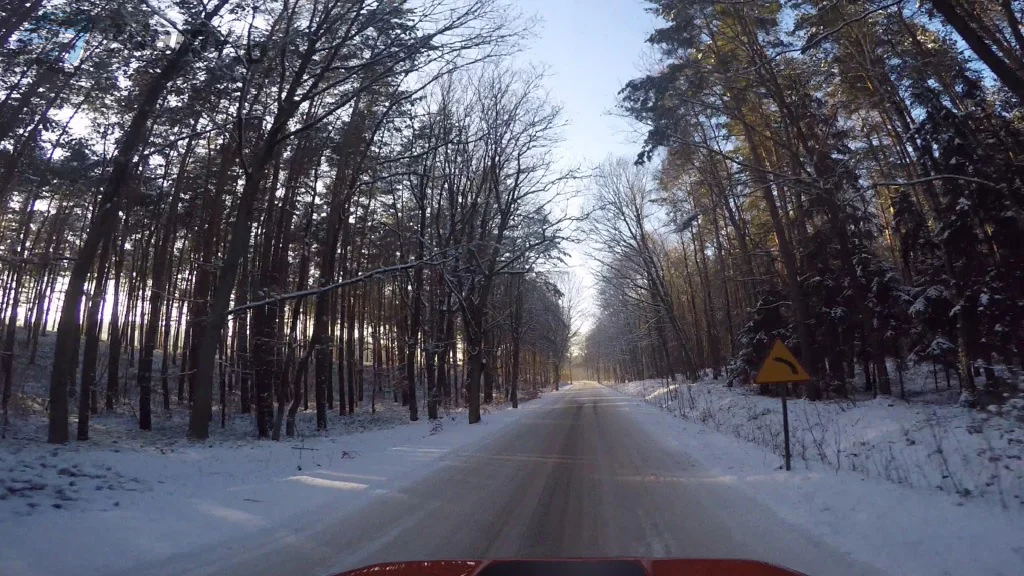
In the photo there is an icy, snow-covered road through a forest with a sign warning about a bend. The risk of skidding is increased by sudden, hard braking - the answer is A.
The Road Traffic Act requires you to drive at a speed that allows you to keep control of the vehicle, taking into account the condition of the road and the weather conditions, and to brake in a way that does not create a danger to traffic safety. On ice the tyres have very little grip; pressing the brake hard locks the wheels (or makes the ABS work non-stop), the car can no longer be steered and slides over the ice like a sledge, often spinning round. Engine braking, from answer B, is exactly the technique for a slippery surface: changing to a lower gear reduces speed gently, without locking the wheels. Driving at a constant speed, from answer C, also does not cause a skid, because it does not change the load on the wheels. On an icy road you do everything smoothly: you slow down early, brake gently, turn calmly, do not accelerate in a bend, and on a longer downhill stretch you change to a lower gear instead of keeping your foot on the brake.
Legal basis: Art. 19 para. 1 and para. 2 point 2 of the Road Traffic Act (Prawo o ruchu drogowym)