
In which of the following situations should you stop cardiopulmonary resuscitation?
Show the correct answer
Correct answer
A. When the injured person starts breathing spontaneously.
Explanation
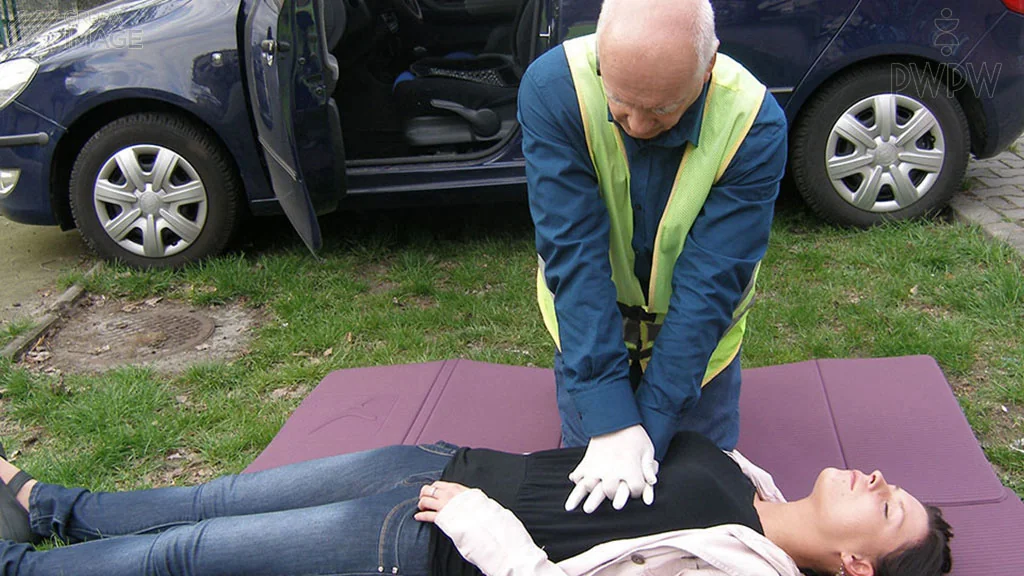
In the photo a man in a high-visibility vest is doing chest compressions on a woman lying on a mat next to a car. You stop cardiopulmonary resuscitation when the casualty starts breathing on their own - answer A.
Resuscitation replaces the work of the heart and lungs, so every break means no oxygen for the brain. You continue it until the casualty starts to wake up, move, open their eyes and breathe normally, until the paramedics take over, or until you are too exhausted to go on. A fixed limit of 30 minutes (answer B) does not exist - sometimes effective resuscitation lasts longer, especially until the ambulance arrives. The sight of an approaching ambulance (answer C) is not a reason to stop - you continue compressions until a paramedic says that they are taking over. You do the compressions in the middle of the chest, to a depth of 5-6 cm, at a rate of 100-120 per minute, 30 compressions to 2 breaths.
Legal basis: Art. 44 para. 2 point 1 of the Road Traffic Act (Prawo o ruchu drogowym); Art. 162 § 1 of the Criminal Code