
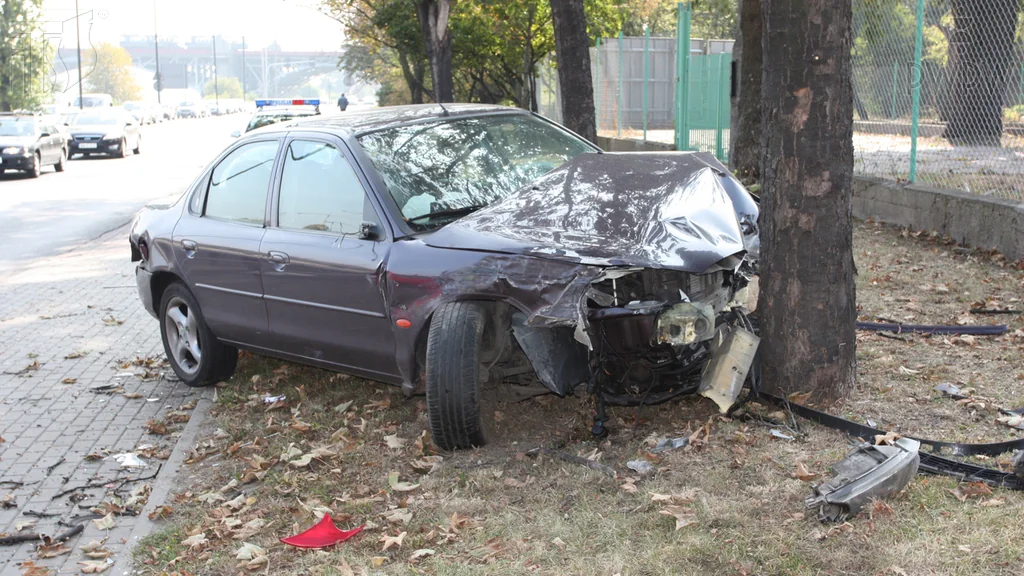
When should you cease to perform resuscitation to a person who is a victim of an accident?
Show the correct answer
Correct answer
B. After restoration of life functions (pulse, breathing).
Explanation
In the photo, a passenger car with its front smashed against a tree growing next to the pavement. You stop resuscitation when the casualty's vital functions have been restored - answer B.
Chest compressions and rescue breaths replace the work of the heart and lungs, so every pause means no oxygen for the brain. You continue until the casualty starts to wake up, move, open their eyes and breathe normally, until paramedics take over, or until you are too exhausted to go on. A broken rib (answer A) happens even with correctly performed CPR, especially in older people, and it is not a reason to stop - without CPR the casualty will die. You call the ambulance (answer C) at the beginning, but calling for help alone does not end what you have to do; the dispatcher may even guide you over the phone. If there is a second person, take turns doing the compressions every 2 minutes.
Legal basis: Art. 44 para. 2 point 1 of the Road Traffic Act (Prawo o ruchu drogowym); Art. 162 § 1 of the Criminal Code