
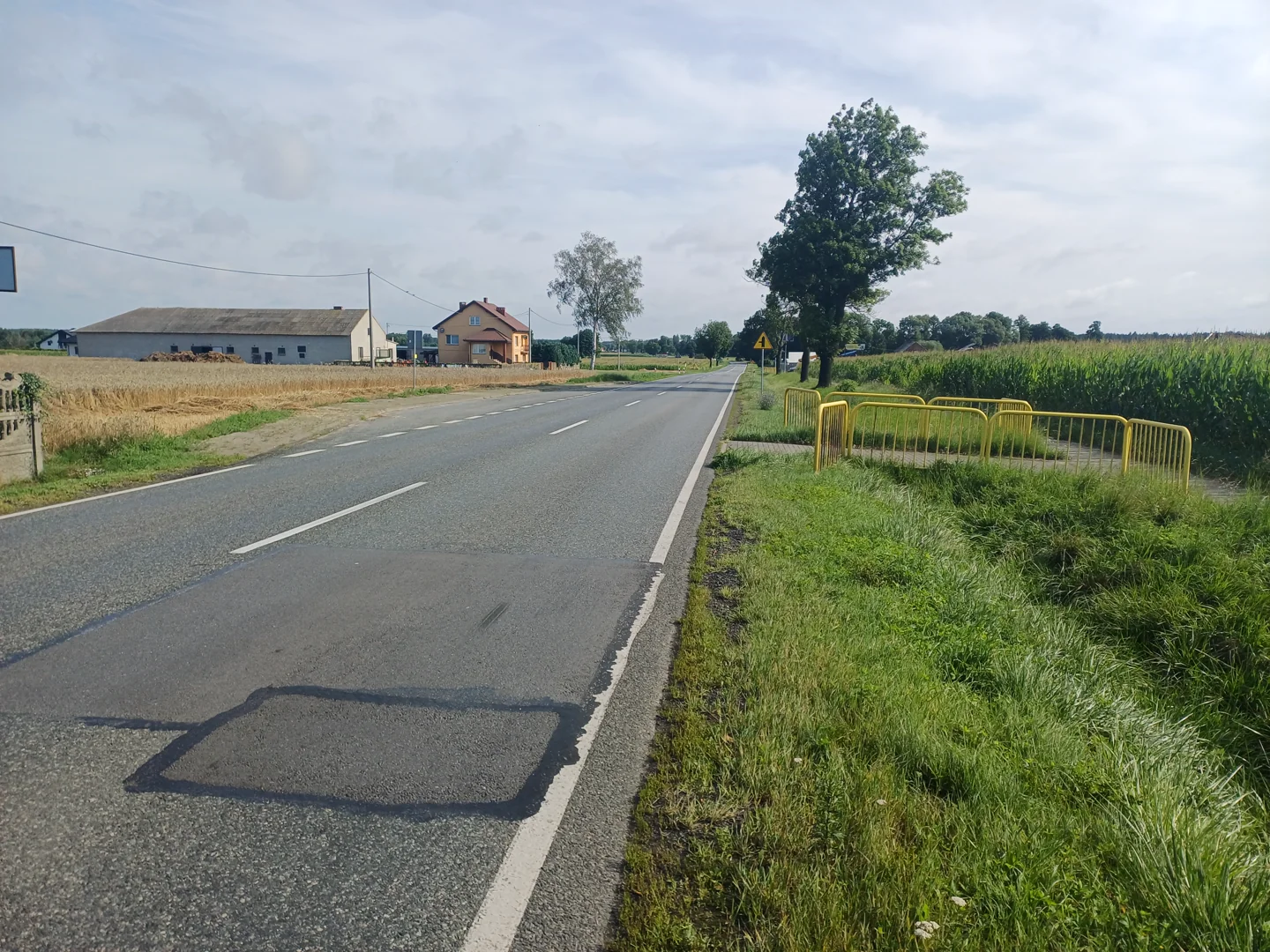
Is the driver approaching the courtesy crossing informed of this by appropriate road signs?
Show the correct answer
Correct answer
NO
Explanation
In the photo you are driving on a road through a village; on the right a pavement with yellow railings reaches the edge of the roadway, and on the left a paved path continues across the shoulder - this is a suggested crossing point (przejście sugerowane), without any signs or stripes. The driver is not informed about it by road signs. The answer is: no.
The Road Traffic Act defines a suggested crossing point as an unmarked, technically adapted place that allows pedestrians to cross the roadway, a cycle path or tram tracks, and which is not a pedestrian crossing. The key word is "unmarked": a suggested crossing point by design has no sign D-6, no stripes on the roadway and no other marking - you will recognise it only by the shape of the road, for example a lowered kerb, a paved path across the shoulder, a traffic island or a pedestrian refuge. A pedestrian may legally cross there, because the Act allows crossing outside a pedestrian crossing at a suggested crossing point, but does so under the general rules: the pedestrian gives way to vehicles. For you this means that in such places - especially near bus stops and shops in villages - you watch the shoulders, because a pedestrian may appear there, even though no sign warns you of it.
Legal basis: Art. 2 point 11a and Art. 13 para. 2 and 3 of the Road Traffic Act (Prawo o ruchu drogowym)